Director Identification Number (DIN) and DPIN for LLP-2026
Director Identification Number (DIN) for Companies and DPIN for LLPs: Legal Framework, Eligibility, Applicability, Application, Allotment and Regulatory Requirements for Individuals, NRIs and Foreign Nationals
Director Identification Number (DIN) or DPIN is a unique number allotted by Central Government, under the Companies Act, 2013, to identify company directors within the Indian Corporate Governance Framework i.e Company and LLP. The primary purpose of DIN is to uniquely identify company directors for the legal and administrative requirements of a company. The DIN under the Companies Act, 2013 also serves as the Designated Partnership Identification Number (DPIN) under the Limited Liability Partnership Act, 2008.
Applicability: the DIN is applicable only to Directors of Companies and Designated Partners of LLPs. No person can be appointed as a Director in a Company or as a Designated Partner in an LLP without a DIN. The term ‘company’ includes all types of companies, such as private companies, public companies, One Person Companies (OPCs), Producer Companies, etc.
What is the Procedure for Applying for Allotment of DIN / DPIN:?
The Ministry of Corporate Affairs (MCA) allots DIN based on the PAN for Indian Nationals and on the passport and other prescribed identification and supporting documents for Foreign Nationals. The PAN serves as the primary identification reference for DIN allotment and verification for Indian Nationals. As per the Companies Act, 2013, the procedure for applying for allotment of a DIN depends on whether the individual is proposed to be appointed as a director in a new company or an existing company.
Procedure for Allotment of Director Identification Number (DIN) / DPIN:
1. For a Director of a New Company [through → SPICe+ (INC-32)] and For a Designated Partner of a New LLP [through → Form FiLLiP]
The Director Identification Number (DIN) application is made through SPICe+ (INC-32) as part of the company incorporation process. DIN can generally be allotted to up to three proposed directors through SPICe+. The DPIN application is made through Form FiLLiP as part of the LLP incorporation process, respectively.
2. For a Director of an Existing Company (through an Application Form DIR-3)
The proposed director must apply through Form DIR-3 before appointment. The procedure is as below:
- Obtain the required Digital Signature Certificate (DSC).
- Prepare Form DIR-3 on the MCA V3 Portal (www.mca.gov.in).
- Enter the applicant’s particulars, including PAN/passport details, name, father’s name, date of birth, nationality and address.
- Attach the prescribed supporting documents, including photograph, proof of identity and proof of residence.
- Attach the Board Resolution proposing the appointment as director (optional).
- Ensure the form is digitally signed by the applicant and digitally verified by the appropriate authorised person of the company/ LLP i.e Existing Director of Company/ Designated Partner of LLP.
- Submit the form electronically on the MCA portal and pay prescribed fee of INR. 500/-.
- MCA processes the application and, if approved, allots the DIN.
Change in DIN Particulars and Maintenance of DIN Active Status
The Director of a Company or Designated Partner of an LLP must file Form DIR-6 with the MCA/ROC, as applicable, along with the prescribed supporting documents, within 30 days of any change in DIN particulars, in accordance with the applicable DIN Rules. No Government fee is applicable for filing Form DIR-6. To maintain the active status of the DIN, the Director or Designated Partner must comply with the prescribed DIR-3 KYC-Web requirements, including the applicable three-year compliance window under the latest rules notified on 31st December, 2025, https://www.mca.gov.in/bin/dms/getdocument?mds=Vk%252FT5sIBKBare6St1b%252FznQ%253D%253D&type=open, verify the registered mobile number and email address, and complete all required compliance’s within the prescribed timelines. For a comprehensive guide to the updated DIR-3 KYC Web requirements, please refer to our detailed article, DIR-3 KYC 2026: New Rules and Compliance Requirements.
Cancelation/ Surrender of DIN:
The DIN holder can surrender or cancel the DIN by filing Form DIR-5 with the MCA/ROC, along with the prescribed supporting documents, upon verification and satisfaction of the requirements as per rules, the MCA approves the application and deactivates the Director Identification Number (DIN).
Important MCA Update for Directors for DIN KYC wef 31st March 2026 as per the vide Notification No. G.S.R. 943(E) dated 31st December, 2025:
https://www.mca.gov.in/bin/dms/getdocument? mds=5wBuXrnw5F5hFYBugmtq1Q%253D%253D&type=open
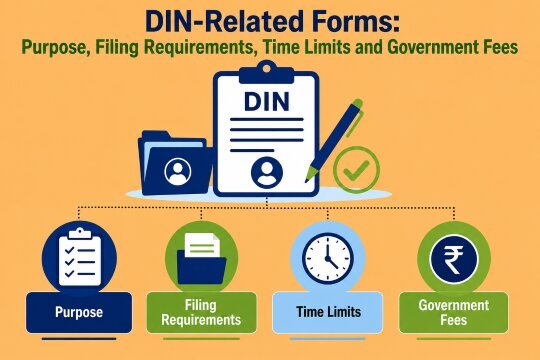
DIN-Related Forms: Purpose, Filing Requirements, Time Limits and Government Fees:Top of Form
| Form Details | Purpose | Time Limit | Government Fee |
| DIR-3 | Application for Allotment of DIN | Before Appointment | ₹500 |
| DIR-3 KYC Web For a comprehensive guide to the updated DIR-3 KYC Web requirements, please refer to our detailed article, DIR-3 KYC 2026: New Rules and Compliance Requirements. | DIN holders to “KYC Compliance/ KYC Update/ Reactivation” Note: The purpose “KYC Compliance” will be enabled for the first time after 31 March 2028 | Annual Based intimation: On or before 30th June of the immediately following every third consecutive financial year Event Based: within a period of thirty days of such event of change | KYC Compliance: NIL Reactivation of DIN: ₹5000 KYC Update: ₹500 |
| DIR-5 | Application for Cancelation/ surrender of DIN | NA | ₹1000 |
| DIR-6 | Intimation of change in DIN particulars | within a period of thirty days of such change | Nil |
| DIR-9 | Filing the report by the company to ROC (MCA) about disqualification of a director | NA | As per Companies Fees Rules |
| DIR-10 | Filing the application to Regional Director (MCA) to remove disqualification of directors | NA | As per Companies Fees Rules |
| DIR-11 | Filing application for notice of resignation of a director to the Registrar (MCA) | Event of Resignation | As per Companies Fees Rules |
| DIR-12 | Particulars of appointment/ Changes of directors/ KMP by Company to the Registrar (MCA) | 30 Days for normal companies (60 days for IFSC company | As per Companies Fees Rules |
| DIR-3C | Intimation of DIN by the company to the Registrar/ ROC. | 15 days of receiving the intimation from the Director | As per Companies Fees Rules |
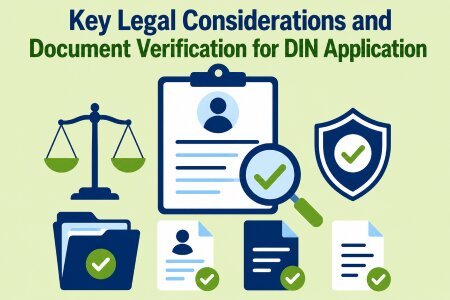
Key Legal Considerations and Document Verification for DIN Application:
- One DIN per Individual: An individual can hold only one Director Identification Number (DIN). A fresh DIN should not be applied for if a DIN has already been allotted/ deactivated.
- PAN-Based Verification for Indian Nationals: For Indian nationals, the DIN application is linked to PAN-based identification and verification. The particulars entered in the application should match the PAN records, in all respects i.e name, date of birth, surname, father’s name, etc.
- Passport-Based Verification for Foreign Nationals: For foreign nationals, passport details are used for identification where PAN is not applicable. The passport should be valid and the particulars entered in the application should match the passport.
- Proof of Identity and Address: The prescribed identity and residential-address documents must be attached and should be valid, legible and properly authenticated wherever required.
- Certification and Digital Signatures: The DIN application must be digitally signed and verified by the persons required under the applicable MCA rules and form requirements.
- Consistency Across Documents: Any mismatch in name, surname, date of birth, father’s name, address or other identification particulars may result in resubmission, rejection or delay.
- False or Misleading Information: Providing incorrect, incomplete or misleading information in the DIN application can have legal consequences under the Companies Act, 2013 and the Bharatiya Nyaya Sanhita, 2023 (BNS).
- Apostille is not required for NRIs and OCI Cardholders who are present in India, in respect of documents issued by the Indian Government.
- OCI Cardholders who hold foreign citizenship and a foreign passport must obtain an apostille for documents issued by the relevant foreign government.
- Documents for Foreign Nationals: Where documents are issued outside India, additional requirements relating to notarisation, apostille/attestation and translation may apply, depending on the document and applicable MCA requirements as the Companies (Appointment and Qualifications of Directors) Rules, 2014 (as amended time to time).
- Verification Before Filing: Before submitting the application, verify the applicant’s existing DIN status, PAN/passport particulars, supporting documents, digital signatures and prescribed attachments to minimise rejection or resubmission.

Practical Issues, Key Queries & Solutions on Director Identification Number (DIN):
Q-1: Can a person hold more than one DIN or DPIN?
Sol: No. A person should have only one DIN for Life-time. If multiple DINs have been inadvertently allotted, the duplicate DIN(s) should be surrendered through the prescribed MCA (Form DIR-5) process.
Q-2: Can the same Director Identification Number (DIN) be used for both a Company and an LLP?
Sol: Yes. A valid DIN can serve as the identification number of an individual acting as a director of a company and/or designated partner of an LLP.
Q-3: Does resignation from all companies automatically deactivate the DIN?
Sol: No. Resignation or cessation as a director does not, by itself, cancel or deactivate the DIN. The DIN is an Identification Number to be a Director in a Company or as a Designated Partner in an LLP, and it serves as fundamental requirement for the Directorship.
Q-4:Can a DIN deactivated for non-filing of DIR-3-KYC be restored?
Sol: Yes, by filing of the Form DIR-3-KYC-Web as applicable under the DIN Rules.
Q-5:Can a person surrender a Director Identification Number (DIN) merely because the person is currently not a director? Sol: No, this is a purely individual strategic needs of the person who holds the DIN.
Q-6:Can an NRI or foreign national obtain a DIN to become a Director in an Indian Company?
Sol: Yes, An NRI or foreign national must obtain a DIN and become a director of an Indian company, For a foreign national, the passport serves as the fundamental identity document.
Practical Issues, Key Queries & Solutions—Continuation:
Q-7:Can a foreign national/ NRI provide a foreign residential address while applying for DIN? Sol: Yes, A foreign national/ NRI residing outside India can provide the actual overseas residential address as the residential address for DIN/KYC purposes. The address should be supported by an acceptable address-proof documents as per MCA DIN Rules. Where documents are not in English, an appropriate English translation may also be required. Foreign documents may require notarisation and apostille, depending on the applicable requirements and country of issuance.
Q-8:Can a foreign national/ NRI complete DIN KYC using a foreign mobile number and foreign address? Sol: Yes, subject to the MCA’s prescribed KYC validation requirements, Foreign/ NRI directors should maintain their registered email/mobile details and overseas residential address accurately in MCA records.
Q-9: Is an NRI automatically treated as a “foreign national” for DIN purposes? Sol: No, This is an important practical distinction. An NRI is generally an Indian citizen residing outside India, whereas a foreign national is a citizen of another country. Therefore, an NRI should not be treated as a foreign national merely because the person has an overseas residential address.
Authored by Team RYmergZ
About the Author:
A Corporate Professional, having the Post Qualification Experience of Fifteen Years Plus, in the areas of Corporate Laws and Governance, Regulatory Reporting, Contract Management, Compliance and Risk Governance.
Please contact us if you require professional advice. https://rymergz.me/contact-us/