Blog

  • Blog - Company Law

    DIR-3 KYC 2026: New Rules, Due Date & Once-in-Three-Years KYC.

    DIR-3 KYC 2026: DIN holders now need to update their KYC details only once every three years instead of every year

    DIR-3 KYC 2026 DIN holders now need to update their KYC details only once every three years instead of every year

    DIR-3 KYC 2026: DIN holders now need to update their KYC details only once every three years instead of every year. The MCA Rules amended on 31st December, 2025 replace annual KYC filing with a simple KYC intimation once every three years. The new KYC Form “DIR-3-KYC-WEB” replaces the earlier “DIR-3 KYC” and “DIR-3 KYC-WEB” forms and provides a simpler process for various KYC purposes.

    The MCA introduced the Companies (Appointment and Qualification of Directors) Amendment Rules, 2025, effective from 31st March 2026, to simplify the DIN KYC process and its related procedures. To maintain an active Director Identification Number (DIN)/Designated Partner Identification Number (DPIN), the Director or Designated Partner must complete the prescribed DIR-3 KYC-Web requirements, comply with the applicable three-year compliance window, and verify the registered mobile number and email address within the prescribed timelines.

    The Companies (Appointment and Qualification of Directors) Amendment Rules, 2025

    https://www.mca.gov.in/bin/dms/getdocument?mds=Vk%252FT5sIBKBare6St1b%252FznQ%253D%253D&type=open,

    Important MCA Clarification on DIN KYC Update for Directors Effective from 31 March 2026 under Notification No. G.S.R. 943(E) dated 31 December 2025:

    https://www.mca.gov.in/bin/dms/getdocument?mds=5wBuXrnw5F5hFYBugmtq1Q%253D%253D&type=open
    DIR-3 KYC-Web Key Applicable Scenarios

    DIR-3 KYC-Web: Key Applicable Scenarios

    Every individual holding a DIN as on 31st March of a financial year must file DIR-3 KYC-Web by 30th June of the next third consecutive financial year, without any fee. If the mobile number, email address, or residential address changes, the DIN holder must file DIR-3-KYC-Web within 30 days of the change, with the applicable fee.

    The Form DIR-3 KYC-Web covers the following scenarios:
    ScenarioPurposeTime LimitGovernment Fee
    Reactivation of DIN  Applicable where the DIN status is “Deactivated due to non-filing of DIR-3-KYC”NA  ₹5000  
    KYC Compliance
    (For Every Three-Year Compliance Window)  
      Applicable, if the DIN status is “Approved”.  30th June of the next third consecutive financial year (*) i.e 30/06/2028 for First KYC WindowNIL    
    Update of Mobile Number/ Email ID/ Permanent and Present Residential AddressApplicable, if the DIN status is “Approved”.   within a period of thirty days of such event of change  ₹500      
    (*) The first three-year compliance window is from 01st April, 2025 to 31st March, 2028, and the “KYC Compliance” function will be enabled on the MCA Portal for the first time after 31st March 2028.
    Practical Issues, Key Queries & Solutions on DIN DIR-3 KYC Compliance

    Practical Issues, Key Queries & Solutions on DIN DIR-3KYC Compliance

    Q-1. What changes were introduced in DIN DIR-3 KYC compliance from 31st March 2026?

    Sol: From 31st March 2026, the revised DIN KYC process requires All DIN holders to complete KYC compliance once every three consecutive financial years instead of every year. The DIN holders must use DIR-3 KYC-Web for the applicable KYC compliance, replacing the earlier DIR-3-KYC and DIR-3-KYC-Web process.

    Q-2. What is the first three-year KYC window, and when will “KYC Compliance” be available on the MCA Portal?

    Sol: The first three-year KYC window is from 1st April 2025 to 31st March 2028. The “KYC Compliance” function will first be available on the MCA Portal after 31st March 2028.

    Q-3. Does the three-year cycle eliminate the requirement to update changed KYC details?

    Sol: No, the three-year cycle applies to the regular KYC compliance requirement. Where the specified personal details change, the DIN holder must update them within 30 days of the change, along with the applicable fee of ₹500.

    Q-4. Is the “KYC Compliance” function applicable to every Deactivated DIN?

    Sol: No, it’s applicability depends on the reason for deactivation and the DIN KYC filing history. In particular, the revised mechanism needs to be distinguished from cases where the DIN was deactivated and the holder had never filed DIR-3-KYC at least once, particularly where the DIN was allotted on or before 31st March 2025.

    Q-5. Will DIN holders with different DIN allotment dates, follow the same KYC Compliance Cycle as per New Rules?

    Sol: Yes, All DIN holders will follow a uniform three-year KYC Compliance cycle, subject to applicable provisions and transitional rules as amended time to time.

    Practical Issues, Key Queries & Solutions on DIN DIR-3 KYC Compliance →

    Q-6. Is DIR-3 KYC-Web applicable to all categories of DIN holders?

    Sol: Yes. DIR-3 KYC-Web applies to DIN holders irrespective of their category or status, including NRI, Foreign Nationals, Independent Directors, Professional Directors, and other Directors, subject to the applicable provisions and transitional requirements.

    Q-7. Does the residential status or category of a Director affect the applicability of DIR-3 KYC-Web?

    Sol: No. The applicability of DIR-3 KYC-Web is determined based on the DIN holder and the applicable KYC requirements, and does not vary merely because the individual is an NRI, Foreign National, Independent Director, Professional Director, or belongs to any other category of Director.

    Q-8. Can an NRI or Foreign Director use a foreign mobile number for DIN DIR-3 KYC-Web?

    Sol: Yes, An NRI or Foreign Director can use a valid foreign mobile number for DIN KYC. An Indian mobile number is not mandatory if the foreign number meets the applicable requirements and can receive the required OTP. The DIN holder can also update the mobile number through DIR-3 KYC-Web when required.

    Q-9. When is Form DIR-3 KYC-Web required to be filed for a DIN allotted during the Financial Year 2025-26?

    Sol: The first filing shall be due from 01st April 2029 to 30th June 2029, and thereafter every third financial year.

    Q-10. What happens if a DIN holder fails to complete DIR-3 KYC, and how can the DIN be regularised?

    Sol: If a DIN holder fails to complete the prescribed DIR-3 KYC within the applicable period, the DIN will be deactivated. To regularise the DIN, the holder must complete the required KYC through the MCA V3 portal and pay the applicable fee or late fee, if any.

    Practical Issues, Key Queries & Solutions on DIN DIR-3 KYC Compliance ■

    Q-11. Where the DIN was allotted on or before 31st March 2025 and the DIR-3 KYC was filed for FY 2025-26, is filing required for FY 2026-27 or FY 2027-28, and when will the next filing be due?

    Sol: Where a Director already filed the Form DIR-3 KYC / DIR-3 KYC-Web for the FY 2025-26, i.e. where DIN allotment date is on or before 31st March 2025, no filing shall be required for FY’s 2026-27 and 2027-28, provided that there is no change in KYC particulars like address, phone number, email id etc. Accordingly, the first filing in such case shall be due from 01st April 2028 to 30th June 2028.

    Q-12. If a DIN is allotted during FY 2025-26 and the Director updates KYC particulars through DIR-3 KYC-Web during FY 2027-28, when will the next KYC compliance filing be due?

    Sol: Where a DIN is allotted on 1st March, 2026 [FY 2025-26] and the Director updates the phone number, email id, or address in FY 2027-28 by filing DIR-3 KYC Web, the three-year compliance cycle shall be reckoned from the FY 2025-26 in which the DIN is allotted. Accordingly, the next DIR-3 KYC Web for KYC compliance shall be due from 1st April, 2029 to 30th June, 2029. Any update made in FY 2027-28, will not impact the cycle for KYC update compliance mechanism.

    Authored by Team RYmergZ

    About the Author:

    A Corporate Professional, having the Post Qualification Experience of Fifteen Years Plus, in the areas of Corporate Laws and Governance, Regulatory Reporting, Contract Management, Compliance and Risk Governance.

    Please contact us if you require professional advice. https://rymergz.me/contact-us/
  • Blog - Company Law

    Director Identification Number (DIN) and DPIN for LLP-2026

    Director Identification Number (DIN) for Companies and DPIN for LLPs: Legal Framework, Eligibility, Applicability, Application, Allotment and Regulatory Requirements for Individuals, NRIs and Foreign Nationals

    Director Identification Number (DIN) or DPIN is a unique number allotted by Central Government, under the Companies Act, 2013,

    Director Identification Number (DIN) or DPIN is a unique number allotted by Central Government, under the Companies Act, 2013, to identify company directors within the Indian Corporate Governance Framework i.e Company and LLP. The primary purpose of DIN is to uniquely identify company directors for the legal and administrative requirements of a company. The DIN under the Companies Act, 2013 also serves as the Designated Partnership Identification Number (DPIN) under the Limited Liability Partnership Act, 2008.

    Applicability: the DIN is applicable only to Directors of Companies and Designated Partners of LLPs. No person can be appointed as a Director in a Company or as a Designated Partner in an LLP without a DIN. The term ‘company’ includes all types of companies, such as private companies, public companies, One Person Companies (OPCs), Producer Companies, etc.

    What is the Procedure for Applying and Allotment of Director Identification Number (DIN)

    What is the Procedure for Applying for Allotment of DIN / DPIN:?

    The Ministry of Corporate Affairs (MCA) allots DIN based on the PAN for Indian Nationals and on the passport and other prescribed identification and supporting documents for Foreign Nationals. The PAN serves as the primary identification reference for DIN allotment and verification for Indian Nationals. As per the Companies Act, 2013, the procedure for applying for allotment of a DIN depends on whether the individual is proposed to be appointed as a director in a new company or an existing company.

    Procedure for Allotment of Director Identification Number (DIN) / DPIN:

    1. For a Director of a New Company [through → SPICe+ (INC-32)] and For a Designated Partner of a New LLP [through → Form FiLLiP]

    The Director Identification Number (DIN) application is made through SPICe+ (INC-32) as part of the company incorporation process. DIN can generally be allotted to up to three proposed directors through SPICe+. The DPIN application is made through Form FiLLiP as part of the LLP incorporation process, respectively.

    2. For a Director of an Existing Company (through an Application Form DIR-3)

    The proposed director must apply through Form DIR-3 before appointment. The procedure is as below:

    1. Obtain the required Digital Signature Certificate (DSC).
    2. Prepare Form DIR-3 on the MCA V3 Portal (www.mca.gov.in).
    3. Enter the applicant’s particulars, including PAN/passport details, name, father’s name, date of birth, nationality and address.
    4. Attach the prescribed supporting documents, including photograph, proof of identity and proof of residence.
    5. Attach the Board Resolution proposing the appointment as director (optional).
    6. Ensure the form is digitally signed by the applicant and digitally verified by the appropriate authorised person of the company/ LLP i.e Existing Director of Company/ Designated Partner of LLP.
    7. Submit the form electronically on the MCA portal and pay prescribed fee of INR. 500/-.
    8. MCA processes the application and, if approved, allots the DIN.
    Change in DIN Particulars and Maintenance of DIN Active Status and Cancelation/ Surrender of DIN

    Change in DIN Particulars and Maintenance of DIN Active Status

    The Director of a Company or Designated Partner of an LLP must file Form DIR-6 with the MCA/ROC, as applicable, along with the prescribed supporting documents, within 30 days of any change in DIN particulars, in accordance with the applicable DIN Rules. No Government fee is applicable for filing Form DIR-6. To maintain the active status of the DIN, the Director or Designated Partner must comply with the prescribed DIR-3 KYC-Web requirements, including the applicable three-year compliance window under the latest rules notified on 31st December, 2025, https://www.mca.gov.in/bin/dms/getdocument?mds=Vk%252FT5sIBKBare6St1b%252FznQ%253D%253D&type=open, verify the registered mobile number and email address, and complete all required compliance’s within the prescribed timelines. For a comprehensive guide to the updated DIR-3 KYC Web requirements, please refer to our detailed article, DIR-3 KYC 2026: New Rules and Compliance Requirements.

    Cancelation/ Surrender of DIN:

    The DIN holder can surrender or cancel the DIN by filing Form DIR-5 with the MCA/ROC, along with the prescribed supporting documents, upon verification and satisfaction of the requirements as per rules, the MCA approves the application and deactivates the Director Identification Number (DIN).

    Important MCA Update for Directors for DIN KYC wef 31st March 2026 as per the vide Notification No. G.S.R. 943(E) dated 31st December, 2025:

    https://www.mca.gov.in/bin/dms/getdocument? mds=5wBuXrnw5F5hFYBugmtq1Q%253D%253D&type=open

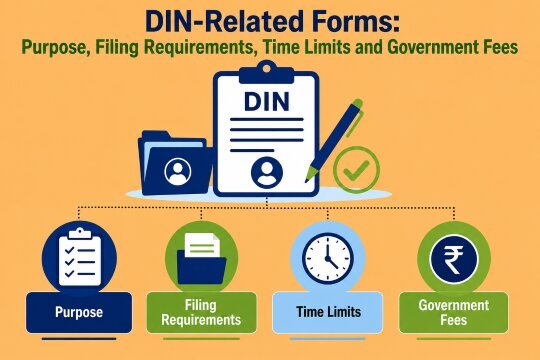
    DIN-Related Forms: Purpose, Filing Requirements, Time Limits and Government Fees
    DIN-Related Forms: Purpose, Filing Requirements, Time Limits and Government Fees:Top of Form
    Form DetailsPurposeTime LimitGovernment Fee
    DIR-3Application for Allotment of DINBefore Appointment₹500
    DIR-3 KYC Web    
    For a comprehensive guide to the updated DIR-3 KYC Web requirements, please refer to our detailed article, DIR-3 KYC 2026: New Rules and Compliance Requirements.        
      DIN holders to “KYC Compliance/ KYC Update/ Reactivation”   Note: The purpose “KYC Compliance” will be enabled for the first time after 31 March 2028  Annual Based intimation: On or before 30th June of the immediately following every third consecutive financial year   Event Based: within a period of thirty days of such event of change  KYC Compliance: NIL   Reactivation of DIN: ₹5000   KYC Update: ₹500      
    DIR-5  Application for Cancelation/ surrender of DINNA  ₹1000
    DIR-6Intimation of change in DIN particularswithin a period of thirty days of such changeNil
    DIR-9    Filing the report by the company to ROC (MCA) about disqualification of a directorNA    As per Companies Fees Rules    
    DIR-10    Filing the application to Regional Director (MCA) to remove disqualification of directorsNA    As per Companies Fees Rules    
    DIR-11  Filing application for notice of resignation of a director to the Registrar (MCA)Event of Resignation    As per Companies Fees Rules  
    DIR-12    Particulars of appointment/ Changes of directors/ KMP by Company to the Registrar (MCA)30 Days for normal companies (60 days for IFSC company  As per Companies Fees Rules  
    DIR-3CIntimation of DIN by the company to the Registrar/ ROC.15 days of receiving the intimation from the DirectorAs per Companies Fees Rules
    Key Legal Considerations and Document Verification for DIN Application
    Key Legal Considerations and Document Verification for DIN Application:
    1. One DIN per Individual: An individual can hold only one Director Identification Number (DIN). A fresh DIN should not be applied for if a DIN has already been allotted/ deactivated.
    2. PAN-Based Verification for Indian Nationals: For Indian nationals, the DIN application is linked to PAN-based identification and verification. The particulars entered in the application should match the PAN records, in all respects i.e name, date of birth, surname, father’s name, etc.
    3. Passport-Based Verification for Foreign Nationals: For foreign nationals, passport details are used for identification where PAN is not applicable. The passport should be valid and the particulars entered in the application should match the passport.
    4. Proof of Identity and Address: The prescribed identity and residential-address documents must be attached and should be valid, legible and properly authenticated wherever required.
    5. Certification and Digital Signatures: The DIN application must be digitally signed and verified by the persons required under the applicable MCA rules and form requirements.
    6. Consistency Across Documents: Any mismatch in name, surname, date of birth, father’s name, address or other identification particulars may result in resubmission, rejection or delay.
    7. False or Misleading Information: Providing incorrect, incomplete or misleading information in the DIN application can have legal consequences under the Companies Act, 2013 and the Bharatiya Nyaya Sanhita, 2023 (BNS).
    8. Apostille is not required for NRIs and OCI Cardholders who are present in India, in respect of documents issued by the Indian Government.
    9. OCI Cardholders who hold foreign citizenship and a foreign passport must obtain an apostille for documents issued by the relevant foreign government. 
    10. Documents for Foreign Nationals: Where documents are issued outside India, additional requirements relating to notarisation, apostille/attestation and translation may apply, depending on the document and applicable MCA requirements as the Companies (Appointment and Qualifications of Directors) Rules, 2014 (as amended time to time).
    11. Verification Before Filing: Before submitting the application, verify the applicant’s existing DIN status, PAN/passport particulars, supporting documents, digital signatures and prescribed attachments to minimise rejection or resubmission.
    Practical Issues, Key Queries & Solutions on Director Identification Number (DIN)
    Practical Issues, Key Queries & Solutions on Director Identification Number (DIN):

    Q-1: Can a person hold more than one DIN or DPIN?
    Sol: No. A person should have only one DIN for Life-time. If multiple DINs have been inadvertently allotted, the duplicate DIN(s) should be surrendered through the prescribed MCA (Form DIR-5) process.

    Q-2: Can the same Director Identification Number (DIN) be used for both a Company and an LLP?
    Sol: Yes. A valid DIN can serve as the identification number of an individual acting as a director of a company and/or designated partner of an LLP.

    Q-3: Does resignation from all companies automatically deactivate the DIN?
    Sol: No. Resignation or cessation as a director does not, by itself, cancel or deactivate the DIN. The DIN is an Identification Number to be a Director in a Company or as a Designated Partner in an LLP, and it serves as fundamental requirement for the Directorship.  

    Q-4:Can a DIN deactivated for non-filing of DIR-3-KYC be restored?
    Sol: Yes, by filing of the Form DIR-3-KYC-Web as applicable under the DIN Rules.

    Q-5:Can a person surrender a Director Identification Number (DIN) merely because the person is currently not a director? Sol: No, this is a purely individual strategic needs of the person who holds the DIN.

    Q-6:Can an NRI or foreign national obtain a DIN to become a Director in an Indian Company?
    Sol: Yes, An NRI or foreign national must obtain a DIN and become a director of an Indian company, For a foreign national, the passport serves as the fundamental identity document.

    Practical Issues, Key Queries & SolutionsContinuation:

    Q-7:Can a foreign national/ NRI provide a foreign residential address while applying for DIN? Sol: Yes, A foreign national/ NRI residing outside India can provide the actual overseas residential address as the residential address for DIN/KYC purposes. The address should be supported by an acceptable address-proof documents as per MCA DIN Rules. Where documents are not in English, an appropriate English translation may also be required. Foreign documents may require notarisation and apostille, depending on the applicable requirements and country of issuance.

    Q-8:Can a foreign national/ NRI complete DIN KYC using a foreign mobile number and foreign address? Sol: Yes, subject to the MCA’s prescribed KYC validation requirements, Foreign/ NRI directors should maintain their registered email/mobile details and overseas residential address accurately in MCA records.

    Q-9: Is an NRI automatically treated as a “foreign national” for DIN purposes? Sol: No, This is an important practical distinction. An NRI is generally an Indian citizen residing outside India, whereas a foreign national is a citizen of another country. Therefore, an NRI should not be treated as a foreign national merely because the person has an overseas residential address.

    Authored by Team RYmergZ

    About the Author:

    A Corporate Professional, having the Post Qualification Experience of Fifteen Years Plus, in the areas of Corporate Laws and Governance, Regulatory Reporting, Contract Management, Compliance and Risk Governance.

    Please contact us if you require professional advice. https://rymergz.me/contact-us/
  • Blog - GST

    GST e-Invoice Generation Made Simple: A Step-by-Step Guide Using “GePP-On” 2026

    GST e-Invoice Generation using GePP-On

    Easy and Simple GST e-Invoice Generation without accounting software and ERP, through GePP-On  

    GST e-Invoice Generation using “GePP-On”: GePP-On is a GST Online Application Tool for Preparing and Printing of the GST e-Invoices Online. The National Informatics Centre (NIC) developed this free, web-based utility tool as part of the GST e-Invoicing system. The only objective of this tool is to facilitate the process of a GST Invoice Entry, Generation of IRN and Invoice Printing.

    E-invoice under GST System: An e-invoice improves readability, accessibility, and authenticity by digital preparation through a standardized regulatory format across the GST ecosystem, including regulatory authorities.

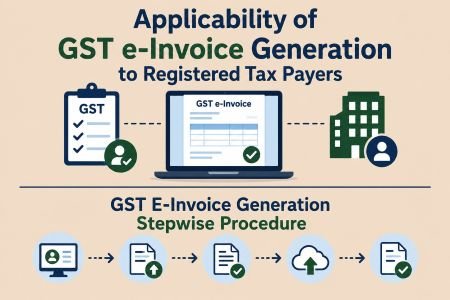
    Applicability of GST e-Invoice Generation to Registered Tax Payers and GST E-Invoice Generation Stepwise Procedure

    Applicability of GST e-Invoice to Registered Tax Payers

    GST e-Invoice generation is mandatory to the registered tax payers, whose aggregate annual turnover (AATO) exceeds ₹5 crore, in any financial year from FY 2017–18. The registered tax payers are required to comply with E-invoice Procedure on crossing of the said threshold in any one of those years, even if turnover falls below ₹5 crore in subsequent years.

    The threshold limits of aggregate annual turnover (AATO) will be computed as per the filed Form of GSTR-3B (Cumulative PAN Based) with the GST Portal, excluding the GST (including compensation cess) and the value of inward supplies received on which they are liable to pay tax under RCM. The said threshold limits are expected to change in the upcoming years, subject to the changes in GST rules and regulation in force.

    GST E-Invoice Generation Stepwise Procedure

    1. The registered taxpayer or accountant will prepare the invoice for their business transactions as usual.
    2. IRP (Invoice Registration Portal) is a digital platform authorised by the government, to validate the GST Invoice.
    3. The regular invoice should be submitted to the IRP (Invoice Registration Portal) through modes as below.
      (a) Directly through the IRP (or)
      (b) ERP/accounting software (or)
      (c) GST Suvidha Provider (GSP) (or)
      (d) GePP-On GST Application (facilitate the automatic submition to IRP)
    4. The Common Validation Errors can be interpreted with the help of the following Weblink
      https://einvoice1.gst.gov.in/others/geterrorcodes/INV
    5. After submission, IRP will validate the data in the invoice.
    6. After validation IRP will generates a unique number to each invoice called “IRN – Invoice Reference Number” and “QR Code” 
    7. An E-invoice is an invoice consist of IRN Invoice Reference Number and QR Code which shows that the invoice was authenticated by the government.
    8. Print or save the e-Invoice on Generation at IRP Portal
    9. Eventually, E-Invoice will be auto-updated at the GST Portal (Form GSTR-1).

    Invoices and Notes covered under E-invoice:

    1. Regular B2B Invoices including Export Invoice, Invoice to SEZ Units/ Developers.
    2. Invoice by SEZ Units/ Developers (if specially notified) 
    3. Credit Note and Debit Note
    4. E-Invoices do not cover B2C invoices

    Registration on the GST “E-invoice System” before using “GePP-On”

    The registered taxpayers have to visit the “GST e-invoice system” (https://einvoice1.gst.gov.in/) and click on the tab Registration and follow the instructions to create credentials and then log into the e-invoice system by using the created credentials. User must use the same credentials to access ‘GePP-On’ for GST e-Invoice Generation (IRN).

    Features and Benefits of GePP-On for GST E-Invoice Generation
    Features and Benefits of GePP-On.
    1. It is an open and cost-free web application for GST e-Invoice generation.
    2. User can use the application in desktop, laptop, and mobile device web applications.
    3. It is an independent web application tool and not related to any ERP and Accounting Software.
    4. Availability of options like “Recipient Master” for recipient GSTINs, and “Product Master” for HSNs details, which reduce the effort and time required to enter details.
    5. Users can run the application online as well as offline, prepare and store data on the system or mobile device, and submit it to the portal by going online.
    6. The ability to import and export the backup data to required systems.
    7. An option, “E-way Bill” is available within the menu of “Create e-Invoice”
    8. Printing the e-Invoice with QR code.
    9. Built-in validations to ensure the accuracy of the data entered.
    10. User can modify business unit data by editing the “Profile Tab”.
    11. It is an application that facilitates easy and user-friendly platform for e-Invoice compliance and it is particularly very useful for micro, small and medium enterprises (MSMEs) with limited number of invoices.

    Benefited Business Users: Registered taxpayers with few invoices but covered under the E-invoice applicability will benefit from the usage of “GePP On” due to its smooth integration with the e-Invoice portal, which will enable the generation of IRN without the need for API integration or using the portal’s bulk upload option.

    Significant Options of “GePP-online” Application

    Detailed Explanation about the Significant Options of “GePP-online” Application

    The Registered taxpayer can use the credentials of GST “E-invoice System to login to the “GePP-On” Application for GST e-Invoice Generation (IRN):

    1. Login to Gepp-on: https://gepp.einvoice1.gst.gov.in/#/, after entering the credentials, can view as below:
    2. The Home Page displays a simple dashboard with:
      • a) Pending Invoices, b) Generated Invoices, c) Recipients, and d) Products
    3. Main Menu displays with options like:
      • a) Create invoice, b) Pending invoices, c) Cancel IRN, d) EWB by IRN, e) Generated invoices, f) Recipient Master, g) Product Master, h) Backup/Restore Data, and i) Profile
    4. Options that are clear by their Name are: Create e-invoice, Cancel IRN, Generated e-invoices.
    5. Clarification about the other Options
      • Pending invoices:
        • After entering all invoice details, such as GSTIN, HSN, amount, etc., in the “Create e-Invoice” option, the user can choose either “Save” or “Generate.” The “Save” option allows the user to save the invoice as a draft without generating an IRN, while the “Generate” option allows the user to proceed directly with IRN generation without saving the invoice as a draft.
        • Users can find draft invoices that they have not yet generated under the “Pending Invoices” option. In Simple words i.e Pending for IRN generation.
      • Recipient Master
        • Users can save the GSTIN details of frequently used goods and service recipients or clients through this option. They need to complete this process once.
        • For a new client, users should add the client’s GSTIN to this option.
        • While entering invoice details in the “Create e-Invoice” option, users can select the client’s GSTIN from this master, and the system will automatically pre-fill the other details.
        • This will reduce the effort and time required to enter the same GSTIN for every transaction
      • Product Master:
        • User can save all details of the existing goods and service like HSN code, description, units, price and tax rates for commonly provided goods and service through this option. They only need to complete this process once.
        • In case of new “Goods and Services” (if any) such details should be updated or added in this option only.
        • While entering invoice details in the “Create e-Invoice” option, users can select the product or service details from this master, and the system will automatically pre-fill the saved information.
      • Profile: The user may update their profile settings if any, this is a one-time process. The system will take into account, the supplier/user GSTIN information from said profile settings at the time of IRN generated.
    6. Backup/Restore Data: This option allows users to export and import data from one system or browser to another system or browser respectively.

    For the detailed screen-based explanation, refer to the official GePP-On User Manual available at:

    https://gepp.einvoice1.gst.gov.in/downloads/Gepp_usermanual.pdf

    Challenges and Suggested Remedial Measures for effective use of “GePP-On” for GST e-Invoice Generation

    Challenges and Suggested Remedial Measures for effective use of “GePP-On” for GST e-Invoice Generation:

    1. Enter the details of Recipient Master and Product Master before creating the invoice, as Direct E-invoice Generations is not possible without the master details.
    2. Dependency on the pattern of “Single system and Single browser”, which means if business unit enter its invoice details in one of the systems and using any one browser then data stores in the system is browser dependent and if application opened in same system different browser, then  data will not be available in it.
      • Example: If data entered and stored in GePP-On application by using the Firefox browser, then it will be available in the same Firefox browser on same system. The data as saved will not be further available, if the user logs by using a different browser, such as Google Chrome, on the same system.
      • In “GePP-On”, there is an option “Backup/Restore Data”, to overcome this limitation. The pattern of systematic backups can be taken by using the “Backup” option, and the data can be transferred to another system or browser using “Restore Data” option.
    3. Similarly, saved/ stored details as related to the pending invoices, recipient master, product master, and generated invoices won’t be accessible if the user re-installs the operating system. The saved/ stored data of GePP-On, may be affected if the browser’s local storage/cache or the history is deleted. It is better to ensure a systematic backup plan to overcome these types of issues.
    4. There is a limit of ten invoices that can be kept in “Pending Invoices” for IRN generation. But for a new invoice IRN can be generated directly without cancelling the pending invoices invoices
    Queries & Solutions on GePP-On for GST E-Invoice Generation
    Practical Issues: Queries & Solutions on GePP-On- GST E-invoice Utility Tool

    Q-1: Can users cancel e-Invoices using “GePP-on” if they generated them through the e-Invoice Portal’s bulk upload facility or using an API??

    Sol-1: Yes, one can cancel such E-Invoice using “GePP-on” by providing the IRN or document details like document number.

    Q-2:Can users use GePP-on for multiple GSTINs?

    Sol-2: Yes, only if user has updated one GSTIN in Chrome browser and another GSTIN in other browser like Firefox but two GSTINs cannot be done in one browser.

    Q-3: The IRN count shown in the Dashboard are related only to the E-invoices generated using Gepp-on or includes E-invoices generated using E-Invoice Portal Bulk upload or API?

    Sol-3: The Dashboard shows the IRN count that relates only to the e-Invoices that have been generated using GePP-On application in the same system and in the same browser for the logged in GSTIN, respectively.

    Q-4: Can users generate e-Way Bills using GePP-on for e-Invoices generated through the e-Invoice Portal’s bulk upload facility or using an API?

    Sol-4: Yes, one can generate EWBs for the such E-invoices by providing the IRN number or document details like document number or document date and the Part-B details of the EWB.

    Q-5: Is there any online App to download GePP-On on a Mobile Phone?

    Sol-5: Yes, iOS and Android have apps, the same can be downloaded, respectively.

    Authored by Team RYmergZ

    About the Author:

    A Corporate Professional, having the Post Qualification Experience of Fifteen Years Plus, in the areas of Corporate Laws and Governance, Regulatory Reporting, Contract Management, Compliance and Risk Governance.

    Please contact us if you require professional advice. https://rymergz.me/contact-us/
  • Blog - International Trade

    Import Export Code IEC for Startup, MSME in 2026

    How to Apply for Importer-Exporter Code (IEC): Need, Eligibility and Relevancy to Other Registrations related to International Trade for MSME and Startup.

    Import Export Code IEC i.e Importer-Exporter Code, is a Fundamental Document for the Import and Export of goods and services. The Directorate General of Foreign Trade (DGFT), Ministry of Commerce and Industry, GOI, issues the Importer Exporter Code (IEC), under the Foreign Trade (Development & Regulations) Act, 1992, which is mandatory for Exports or Imports.

    Need of an Import Export Code IEC

    Need of an Import Export Code IEC

    A. Compliance of Regulatory Frameworks

    1. Foreign Trade Policy and Customs Clearances 
    2. Import and export of goods and services
    3. Cross-border financial transactions including abroad fundings like FDI, ECB Etc

    B. Government Benefits

    1. Export of Goods and Services without Payment of GST by execution of a Letter of Undertaking (LUT)
    2. Duty Drawbacks Schemes
    3. Incentives for Special Economic Zone (SEZ), EOU, STP and BTP etc
    4. Benefits under Foreign Trade Policy

    C. Business Transactional Needs

    1. Global Market Advantages
    2. Strategic Advantages for business expansion
    3. Ease of Cross-border Logistics

    Who “can” Apply for Import Export Code IEC:

    1. Individuals and Sole-proprietorships
    2. Partnership under the Indian Partnership Act, 1932
    3. LLP under the Limited Liability Partnership Act, 2008 including Foreign and Govt Companies
    4. Companies under the Companies Act, 2013 including OPC, Foreign and Govt Companies
    5. Foreign subsidiaries, Joint Ventures, and Branch offices under the Companies Act, 2013
    6. Other Structures: Hindu Undivided Families (HUFs), Trusts, Societies, Charitable organizations and NGO’s

    Who “cannot” Apply for Import Export Code IEC:

    1. Any Person and Entities without an active and valid Permanent Account Number (PAN) and Bank Account
    2. Any Person and Entities has been blacklisted and or suspended by the DGFT
    3. The Liaison Office under the Companies Act, 2013, cannot apply for IEC (May occasionally be approved for non-commercial use)

    The Relation between PAN and IEC:

    1. The PAN also functions as IEC on approval of an IEC Application by the DGFT, w.e.f July 1, 2017.
    2. The Rule of “One IEC for One PAN”, shall be applied
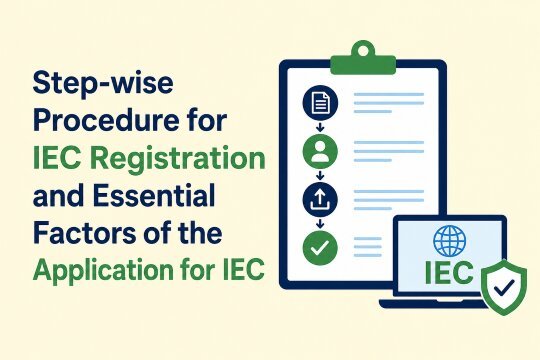
    Step-wise Procedure for IEC Registration and Essential Factors of the Application for Import Export Code IEC

    Step-wise Procedure for Importer-Exporter Code (IEC) Registration:

    1. Visit the DGFT Online Portal and Login after Initial Registration as User (https://www.dgft.gov.in/CP/)
    2. Category of Exporter: Merchant/ Manufacturer, Merchant and Manufacturer, Service Provider and Others
    3. Fill the Application Form ANF 2A with required attachments a below
      • Ensure the Validity of Mobile Number and Email Id by OTP verification
      • Permanent Account Number (PAN) Validation
      • Verification of Bank Account through Cancelled Cheque/ Bank Certificate
      • Business Identity i.e MSME Registration, Labour Licence, Certificate of Incorporation etc
      • Address Proofs: Aadhaar Card Valid for Proprietors and Individual, Rental Agreement/ Lease Deed/ Property Tax Receipt/ Sale Deed/ Ownership Proof/ Electricity Bill etc.
      • Passport Sized Photograph of the Proprietor/ Authorised Signatory  
    4. Details of Export Oriented Unit (EOU), Electronic Hardware Technology Park (EHTP) Scheme, Software Technology Park (STP) Scheme or Bio- Technology Park (BTP) etc, If applicable.
    5. Selection of the Details of Import and Export of goods and services.
    6. Submission of the Application with the Digital Signature/ E-Sign/ Aadhaar Verification. The details available with attached weblink (https://www.dgft.gov.in/CP/)
    7. An application fee of INR. 500/- is required for an initial application of IEC, and INR. 200/- applicable only for the structural modifications of details and “Zero” for other changes and the linkage of an IEC allotted before the July 1, 2017.  
    Essential Factors of the Application for Importer-Exporter Code (IEC)
    • The Regional Jurisdiction of the DGFT is applicable based of the Place of Business of Entity.
    • The DGFT Online Portal integrates the Ministry of Corporate Affairs (MCA) (www.mca.gov.in) database to pre-fill the director master data for registered LLPs and Companies.
    • Applicants should ensure the integration of Aadhaar and PAN data to sign an IEC Application through Aadhaar Validation  
    • The Persons importing or exporting goods for personal use with no connection to any trade, manufacture and agriculture do not need to take IEC.
    • The Government Departments have been operating with the special IEC numbers with ten digit format.
    • The IEC Management Function on the DGFT Online Portal also enables the users to apply for IEC changes, such as profile link, view, print, update, modify, surrender, request for revoking suspensions or cancellations, mergers and demergers etc.   

    Renewal and Update of the IEC: An IEC is issued with lifetime validity in general but renewal by updating is on annual basis (financial year) which is mandatory as per the regulations with window between April 1 and June 30. This is an annual process even if there are no updates to the business information, otherwise, the IEC will be deactivated.

    Renewal and Update of the IEC and The registrations hereunder require mandatory Import Export Code IEC alignment
    The registrations hereunder require mandatory Importer-Exporter Code (IEC) alignment: – It is hereby noted that the list is not exhaustive.
    • Registration as Exporter with the Spices Board, Coir Board, Rubber Board, Tobacco Board, Tea Board, Coffee Board, Coconut Development Board, Jute Board and Central Silk Board.
    • The Legal Entity Identifier (LEI), is an Identification Code issued by Legal Entity Identifier India Limited (LEIL), a wholly-owned subsidiary of the Clearing Corporation of India Limited (CCIL), to ensure the legitimacy of large financial transactions and ease the export credit for international trade.
    • The GST Registration Number (GSTIN) issued under the CGST Act, 2016: Fundamentally No mandatory alignment with IEC but mandatory for Export of Goods and Services without Payment of GST by execution of a Letter of Undertaking (LUT).  
    • Registration as Exporter with APEDA (Agricultural Products), MPEDA (Marine Products), FSSAI License (food exporters).
    • AD Code (Authorized Dealer) Requires an active IEC to link the bank account with customs at the port i.e Sea Port or Air Port etc.
    • DGFT Export Schemes (RoDTEP / Drawbacks): To claim the duty drawbacks or international trade benefits from the Government.
    • Registered Startups/ Companies/ LLP at Special Economic Zone (SEZ), EOU, STP and BTP etc.
    • Registrations with FIEO (Federation of Indian Export Organisations), Apparel Export Promotion Council (AEPC), Council for Leather Exports (CLE), Pharmexcil (Pharmaceuticals Export Promotion Council), EEPC India (Engineering Export Promotion Council), GJEPC (Gems and Jewellery Export Promotion Council), and ICEGATE Registration (Indian Customs Electronic Gateway).
    Queries & Solutions on Import and Export IEC
    Practical Issues: Queries & Solutions on IEC

    Q-1: Does an IEC holder have to file regular or nil returns like GST, ROC or Income Tax?
    Sol: No. The IEC is a legal status identification code, not a tax record identification number. There is no need to file any returns to keep it active. You need to renewal by updating on annual basis with window between April 1 and June 30.

    Q-2: If multiple manufacturing units in two states under the same Entity PAN. Do we need IEC for each of units?

    Sol: No. You cannot have multiple IECs. The Rule of “One IEC for One PAN”, shall be applied. The branches can be managed by adding them under one single IEC. Register your additional units by updating the “Branch Details” section on the DGFT Online Portal.

    Q-3: What happen if missed the annual profile update deadline on June 30, 2026. What are the immediate consequences at DGFT/ customs, and how do we re-activate the IEC?
    Sol: The Import Export Code IEC was automatically deactivated on July 1, 2026. Customs via ICEGATE will block your operations. You can re-activate through the DGFT Online Portal. There is no monetary penalty, and reactivation takes three to seven working days.

    Practical Issues Continuity-1

    Q-4: Can a foreign national or an NRI apply for an IEC to start a trade business in India?
    Sol: Yes, the entity must possess a valid PAN after Registration under the Indian Laws, a place of business address in India, and an active corporate current bank account. The foreign national can e-sign the application using a Digital Signature Certificate (DSC).

    Q-5: I am a gig software engineer receiving international contract works. Do I legally require an Import Export Code IEC if I do not deal physical goods?

    Sol: Yes. Indian banks require an IEC to process foreign inward remittances for services under FEMA and RBI regulations.

    Q-6: What is an Authorized Dealer Code, and why is our new IEC not working at the port despite being active on the DGFT site?

    Sol: Your Import Export Code IEC, allows you to trade, but you cannot clear customs until you register an Authorized Dealer (AD) Code. Request your bank to issue an AD Code confirmation letter, and upload it directly to the port profile on the ICEGATE portal.

    Q-7: What is the difference between IEC requirements for export of goods and export of services?
    Sol: IEC is generally required for exporting goods. For exporting services, IEC is required only in specified cases under the applicable DGFT rules.

    Q-8: What is the difference between IEC and an export licence?

    Sol: IEC identifies an importer or exporter. An export licence allows the export of specific, restricted, or controlled goods as required under applicable regulations.

    Q-9: Is an IEC sufficient to export a product listed under SCOMET?

    Sol: No, an IEC only identifies you as an importer or exporter. If your product is on the SCOMET list, you need a separate SCOMET export licence from DGFT. You can apply for the licence through the DGFT portal using your valid IEC.

    Authored by Team Rymerg

    About the Author:

    A Corporate Professional, having the Post Qualification Experience of Fifteen Years Plus, in the areas of Corporate Laws and Governance, Regulatory Reporting, Contract Management, Compliance and Risk Governance.

    Please contact us if you require professional advice. https://rymergz.me/contact-us/
  • Blog - Company Law

    “One Person Company (OPC)”: Its Benefits and Features.

    What is One Person Company OPC

    “One Person Company (OPC)”: Its benefits, features and as a type of Private Limited Company under the Indian Corporate System.

    A One Person Company (OPC) is a version of mixed business structure that combines the limited liability protection of a Private Limited Company with the features of a sole proprietorship under the Companies Act, 2013.

    One Person Company facilitates a single entrepreneur to run the company on his/ her own. OPC represents a type of the private limited company under the Companies Act, 2013

    OPC Name Examples : The word “OPC” shall be inserted as follows as per the company name regulations.

    ABC Software (OPC) Private Limited

    XYZ Exports (OPC) Private Limited

    one person company OPC registration and Basics of Company Registration including One Person Company

    Basics of Company Registration including One Person Company

    The Ministry of Corporate Affairs, is the apex regulator for registration and regulation of companies in India, as governed under the Companies Act, 2013.https://www.mca.gov.in/content/mca/global/en/home.html

    The Company is an artificial juristic person with legal distinct identity from its Shareholder, Directors and Other Key Managerial Personal as defined under the Companies Act, 2013.The Company is a Separate Legal Entity in the eyes of law and society

    Registration procedure of OPC and Core concepts of OPC, how to register one person company in India

    Strategic Legal Considerations in the matter of the One Person Company Registration in India:

    1. OPC is a Private Limited Company with one sole member who can also act as Director.

    2. The OPC can have more than One Director with maximum limit of Fifteen.

    3. The member of OPC, shall nominate a person as his/her Nominee with prior written consent, who shall become the member of that OPC, in the event of the death of member or incapacity to contract, respectively.

    4. A “minor” cannot become a member or nominee of the OPC or hold shares with beneficial interest.

    5. A person shall not be a member or nominee in more than one OPC at any point of time.

    6. A single person can act as Member in One OPC and as Nominee in other One Person Company. If a nominee place triggers and said person becomes a member in two OPCs, then within a period of 180 days, he/she should choose any one OPC as a member and intimate the same to the MCA.

    7. An OPC cannot carry Non-Banking Financial Investment (NBFC) activities, including investment in securities of any Company and LLP.

    8. The member or shareholder of an OPC can be an Indian resident individual or non-resident Indian subjected to his/her stay in India for a period of not less than 120 (one hundred and twenty days) during the immediately preceding financial year. Hence, the Company Law allows NRI to register an OPC in India.

    9. Company Law prohibits a Foreign National from forming an OPC in India

    10. An OPC can convert into a private or public company but cannot convert into a “Section 8 company,” while a private company may convert into an OPC.

    Features and Benefits of one person company

    The Benefits and features of One Person Company (OPC) for Indian Entrepreneurs and Startup Founders:

    • A feature of an OPC is forming a separate legal protection between personal and corporate wealth/Assets. Shareholder/ Member personal assets are legally inaccessible to the business creditors, and liability is strictly limited to the unpaid value of their subscribed share capital.
    • The mandatory clause of an appointment of nominee ensures an immediate transfer of ownership without stumbling operations and also ensures perpetuity.
    • In case of death of member, the One Person Company Contracts or agreements remains unaffected due to the Transmission of shares to nominee as per the Companies Act, 2013.
    • The One Person Company can hold all types of tangible properties, like land, buildings, etc., and intangible properties like intellectual property (IP), know-how, Trademarks, Patents and other forms of Capital in its own name.
    • OPCs are legally relieved from convening General Meetings i.e., Annual General meeting or Extraordinary General Meetings, as per the Company Law, being operated by a Single Member.
    • OPCs are legally also relieved from convening mandatory number of Board Meetings under the Companies Act, 2013, subjected to Minimum of Two Board Meetings.
    • An OPC can, at its convenience/ requirements, voluntarily convert to a Private Limited Company and can preserve its past track record, GST/ PAN history, Company Bank accounts, properties and other contractual rights and obligations.

    Special Advantages for Tech-startups, Technocrat Projects

    Special Advantages for Tech-startups, Technocrat Projects, as OPC has enabled to get registrations under the MSME/ Udyam, Startup India Schemes, Standup India Schemes, holding of registrations of Import Export Code (IEC), FSSAI, APEDA, Spices Board, Rubber Board, Coir Board etc               

    what is meant by one person company , what one person company, how many members can be there in one person company

    One Person Company (OPC) Frequently Asked Questions (FAQs):

    Q-1: Is the foreign citizen and national but a person of Indian origin eligible to register an OPC in India?

    No, Persons of Indian Origin (PIO) or Overseas Citizens of India/ OCI Card Holders, who have taken up foreign citizenship and passports cannot form an OPC in India.

    Q-2: Can a corporate body eligible to register an OPC?

    No. According to the Companies Act, 2013, Only natural persons are eligible to register the OPC.

    Q-3: Is there any minimum authorised and paid-up capital requirement for starting a OPC?

    No. The Companies Act, 2013 does not mandate capital requirement

    Q-4. Can an OPC invest by purchasing or subscribing equity shares in another Private Limited Company?

    No. An OPC cannot allowed to invest/ purchase shares/ ownership rights in any Company/ LLP/ Body Corporate.

    Q-5. Can an OPC accept Foreign Funding?

    No, FEMA Regulations prohibit an OPC from accepting foreign funding/FDI/ECB.

    FAQ Continuity-1.

    Q-6. Can an OPC give secured and unsecured loans to other OPC’s/ Companies?

    Yes, It can lend money to another OPC/ body corporate out of profits generated from its business operations, subject to the provisions of the Companies Act, 2013 as related to the inter corporate loans

    Q-7. What happens to the OPC in the event that the only member is officially declared bankrupt under the Insolvency Laws?

    The member loses his ability to enter into contracts if a court finds them to be legally insolvent. Eventually, the Nominee can become the Member of the OPC, subject to the Transfer of the Ownership of the Shares, subject to the provisions of the Companies Act, 2013.  

    Q-8 Is apostillation of all Documents as related to Identification of an Non-Resident Indian (NRI) is required to form an One Person Company (OPC) in India?

    No, in case of travel to India to register a OPC. Apostillation will be application where he/ she resides the country which is a part of Hague Convention.

    Q-9. When is an attestation by the Indian Embassy and Consulate, required?

     Applicable, where an NRI resides in Non-Hague Convention Countries (e.g., UAE, Saudi Arabia, Singapore).

    Authored by Team RYmergZ

    About the Author:

    A Corporate Professional, having the Post Qualification Experience of Fifteen Years Plus, in the areas of Corporate Laws and Governance, Regulatory Reporting, Contract Management, Compliance and Risk Governance.

    Please contact us if you require professional advice. https://rymergz.me/contact-us/
       

  • Blog - Intellectual Property

    Role of Intellectual Property in Corporate Brand Protection

    Brand safety cannot be ensured by registering a name as Company/LLP

    Role of Intellectual Property in Market Positioning, Branding, and Global Trade

    Safeguarding business brand identity and market value is far more vital than mere entity registration under corporate law. Startup Business founders and prospective entrepreneurs must understand the differences between corporate entities and intellectual property protections. This article explores the legal foundations of Companies, Limited Liability Partnerships (LLPs), and Trademarks, their value to stakeholders, and their strategic impact on business operations.

    Legal Foundations and Genesis: Understanding corporate structures and intellectual property requires analyzing their distinct statutory frameworks.

    DetailsCompanyLLPTrademark
    Applicable LawCompanies Act, 2013Limited Liability Partnership Act, 2008Trade Marks Act, 1999
    Function    Creates a separate legal entity distinct from its shareholders, directors and administrationHybrid structure combining the operational flexibility of a traditional partnership with the limited liability of a company.Protects intangible intellectual property rights rather than creating a business entity. Protects brand identity, logos, and distinct market markers.
    Primary Object        Offers perpetual succession and limited liability. It operates as an artificial juridical person capable of holding property and suing or being sued in its own nameInternal structure is governed by a mutual LLP Agreement rather than rigid statutory provisions, offering compliance relief for small and medium enterprises.  Grants exclusive statutory rights to use a specific mark (name, logo, slogan, or shape) in commerce. It prevents unauthorized third parties from capitalizing on the brand’s goodwill. Can be assigned, licensed, or sold globally

    Value to Stakeholders through Branding

    Value to Stakeholders
    StakeholdersCompany and LLPTrademark
    Shareholders and Investors  Provide limited liability, protecting personal assets from business debts. Equity shares in a Company offer clear valuation metrics and exit routes for Venture Capital (VC) and Private Equity (PE) firms through secondary markets and public offerings.Drive enterprise value. Investors evaluate trademark portfolios to ensure a target entity owns its brand rights exclusively, avoiding future infringement liabilities.
    Consumers and Other Stake Holders    Ensure corporate accountability, financial transparency, and compliance via public registries like the Ministry of Corporate Affairs (MCA) and other regulators.  Serve as a badge of origin and quality assurance. They protect consumers from confusion, deception, and counterfeit goods in the open market.

    Market Positioning, Branding, and Global Trade

    When evaluating market positioning across retail, wholesale, and international trade, trademark registration heavily prevails over mere corporate name registration. Ministry of Corporate Affairs (MCA) name approval for companies and Limited Liability Partnerships (LLPs) secures only a local corporate registry status (within India); it does not grant a right to use that name in commerce, nor does it secure exclusive, market-wide brand trading rights. Consequently, trademarks command absolute priority in retail, e-commerce, and export trades, providing the definitive legal framework required to protect a brand from infringement and establish nationwide market exclusivity.

    The Company/ LLP Registration: The Company/ LLP name approval from the Ministry of Corporate Affairs (MCA) https://www.mca.gov.in/content/mca/global/en/home.html establishes entity-level exclusivity against identical Company or LLP registrations, but it does not confer proprietary branding rights. Operational use of the approved name remains strictly subject to trademark laws, meaning company registration provides no legal defence against infringement claims if the name conflicts with a pre-existing registered trademark.

    Retail and E-Commerce Dominance: “Verified trademark registration” is the primary mechanism for controlling product listings and removing counterfeiters on major e-commerce platforms like Amazon and Flipkart.

    Import and Export Operations and Customs Enforcement: Registered trademarks are essential for cross-border intellectual property protection, as customs authorities rely entirely on national trademark databases to identify and confiscate counterfeit goods. In contrast, a corporate name only registers a business entity locally and provides no legal authority to stop infringing imports. To prevent international piracy, companies must record their active trademark registrations directly with global customs agencies, enabling border officers to legally seize and destroy unauthorized cargo.

    Name Changes of Companies and LLPs: The Role of Intellectual Property

    Name Changes of Companies and LLPs: The Role of Trademark/Brand/Copyright:

    Altering the corporate name of a Company or Limited Liability Partnership (LLP) requires strict compliance with statutory frameworks beyond corporate law, specifically the Trade Marks Act and the Copyright Act. Failure to conduct due diligence under these statutes can result in infringement claims, injunctions, and forced subsequent alterations.

    • Preventing Infringement Litigation under the Trademark Law: Under Section 4 and Section 16 of the Companies Act, 2013, the MCA will reject a proposed corporate name change if it is identical to or closely resembles an existing registered trademark.
    • Copyright Law: Under the Copyright Act, 1957, copyright ownership attaches automatically upon creation if a corporate name change involves a new logo or stylized artistic text. Registering this copyright prevents competitors from copying the exact visual design of the corporate identity.
    • Passing-Off Risks: Changing a corporate name to match a competitor’s unregistered but popular brand name can trigger a common-law “passing-off” lawsuit, resulting in injunctions and damages.

    Strategic Brand Value: Driving Corporate Success in M&A, IPOs, and Financial Distress:

    Intellectual property acts as a critical financial asset during corporate transactions, offering value through asset sales and collateral in distress scenarios, higher valuations in M&A, and competitive advantage in IPOs. A strong IP portfolio ensures market confidence and drives valuation in both mergers and public offerings.

    • Financial Distress and Insolvency: The Insolvency and Bankruptcy Code (IBC), 2016 values registered trademarks as intangible corporate assets. If a company faces liquidation, liquidators can auction, sell, or license its trademark portfolio separately to maximize recoveries for financial creditors.
    • Mergers & Acquisitions (M&A): In M&A transactions, comprehensive IP due diligence is essential. A robust trademark portfolio increases corporate valuation, validates market dominance, and justifies premium acquisition prices.
    • IPOs, SME-IPOs, and Private Equity: Institutional investors and retail markets evaluate a company’s proprietary technology and brand equity before investment. Prospectuses filed for Initial Public Offerings (IPOs) require detailed disclosures of all registered, pending, and disputed trademarks. Unprotected brands create significant investment risks, which can negatively affect share pricing.
    • Strategic Contracts: Companies can leverage trademarks through franchising models, technology transfers, and licensing agreements to generate high-margin royalty streams without expanding physical infrastructure.
    Specialized Frequently Asked Questions (FAQ) on Corporate Brand Protection

    Specialized Frequently Asked Questions (FAQ) on Business Brand Identity Management Beyond the Registrations of Companies and LLPs.

    1. Does registering a company name with the MCA give me the right to use it as a brand name?

    No. MCA name approval only confirms that no other company or LLP shares that corporate name. It does not protect you against trademark infringement if the name matches a registered trademark owned by someone else.

    2. Can an individual own a trademark, or must it be registered by a Company/LLP?

    An individual can own a trademark. The owner can later assign, sell, or license it to a Company, LLP, or any other commercial entity through a legal deed.

    3. What happens if my corporate name matches someone else’s registered trademark?

    The trademark owner can file a lawsuit for infringement or passing off. This can lead to court injunctions, financial penalties, and an MCA order forcing you to change your corporate name.

    4. Can a trademark be registered prior the Company or LLP is incorporated?

    Yes. An individual or promoter can file a trademark application as a “proposed to be used” mark. Once the Company or LLP is incorporated, the applicant can officially assign to the new corporate entity.

    5. How long do Company, LLP, and Trademark registrations valid?

    Government authorities keep Company and LLP registrations valid indefinitely as long as owners maintain annual statutory filings. A trademark registration remains valid for 10 years, and owners can renew it indefinitely every 10 years.

    6. Can an LLP transition into a Company while keeping its registered trademarks?

    Yes. During the conversion process, the trademark assets can be transferred to the new corporate entity through an assignment deed or operation of law, updating the registry via official structural filings.

    FAQ Continuity-1.

    7. What is the difference between Copyright and Trademark for a business?

    Trademarks protect brand identities, logos, slogans, and product names used in trade. Copyright protects original literary, dramatic, musical, and artistic works, such as website source code, marketing copy, and promotional videos.

    8. Can a trademark asset protect a company from bankruptcy liquidation?

    No. A trademark cannot stop liquidation, but it can be sold or licensed during the process to generate revenue and help pay off outstanding creditors.

    9. Can I protect my brand name internationally with an Indian Company registration?

    No. An Indian corporate registration only applies domestically. To protect your brand internationally, you must file trademark applications in individual target countries or use the international Madrid System.

    10. What is a trademark class, and why does it matter to a Company or LLP?

    The trademark registry divides goods and services into 45 distinct classes. A business must register its mark in the specific classes that match its commercial operations to secure proper protection.

    11. Can a company register a trademark for a color or a sound?

    Yes. Non-traditional trademarks, including distinct color combinations and unique sound clips, can be registered if they uniquely identify the brand to consumers.

    12. Can a trademark application be rejected if the word is generic?

    Yes. Under Section 9 of the Trade Marks Act, 1999, absolute grounds for refusal apply to generic terms (e.g., registering “Apple” for selling physical apples) because they lack distinctiveness.

    FAQ Continuity-2

    13. What is the difference between the ™ and ® symbols?

    The ™ symbol indicates an unregistered trademark that is currently being claimed or processed but no vested legal rights under the trademark law. The ® symbol can only be used after the trademark is officially registered with the TM registry.

    14. Is trademark insurance available for Companies and LLPs?

    Yes. Specialized intellectual property insurance exists to help businesses cover the legal costs of defending their trademarks or pursuing infringement claims against counterfeiters.

    15. Can a company use its trademark as collateral for a bank loan?

    Yes. Financial experts can value registered trademarks, and corporations can use them as intangible collateral to secure credit facilities, loans, and structured financing.

    Authored by Team Rymergz

    About the Author:

    A Corporate Professional, having the Post Qualification Experience of Fifteen Years Plus, in the areas of Corporate Laws and Governance, Regulatory Reporting, Contract Management, Compliance and Risk Governance.

    Please contact us if you require professional advice. https://rymergz.me/contact-us/