• Blog - International Trade

    Import Export Code IEC for Startup, MSME in 2026

    How to Apply for Importer-Exporter Code (IEC): Need, Eligibility and Relevancy to Other Registrations related to International Trade for MSME and Startup.

    Import Export Code IEC i.e Importer-Exporter Code, is a Fundamental Document for the Import and Export of goods and services. The Directorate General of Foreign Trade (DGFT), Ministry of Commerce and Industry, GOI, issues the Importer Exporter Code (IEC), under the Foreign Trade (Development & Regulations) Act, 1992, which is mandatory for Exports or Imports.
    Need of an Import Export Code IEC

    Need of an Import Export Code IEC

    A. Compliance of Regulatory Frameworks

    1. Foreign Trade Policy and Customs Clearances 
    2. Import and export of goods and services
    3. Cross-border financial transactions including abroad fundings like FDI, ECB Etc

    B. Government Benefits

    1. Export of Goods and Services without Payment of GST by execution of a Letter of Undertaking (LUT)
    2. Duty Drawbacks Schemes
    3. Incentives for Special Economic Zone (SEZ), EOU, STP and BTP etc
    4. Benefits under Foreign Trade Policy

    C. Business Transactional Needs

    1. Global Market Advantages
    2. Strategic Advantages for business expansion
    3. Ease of Cross-border Logistics

    Who “can” Apply for Import Export Code IEC:

    1. Individuals and Sole-proprietorships
    2. Partnership under the Indian Partnership Act, 1932
    3. LLP under the Limited Liability Partnership Act, 2008 including Foreign and Govt Companies
    4. Companies under the Companies Act, 2013 including OPC, Foreign and Govt Companies
    5. Foreign subsidiaries, Joint Ventures, and Branch offices under the Companies Act, 2013
    6. Other Structures: Hindu Undivided Families (HUFs), Trusts, Societies, Charitable organizations and NGO’s

    Who “cannot” Apply for Import Export Code IEC:

    1. Any Person and Entities without an active and valid Permanent Account Number (PAN) and Bank Account
    2. Any Person and Entities has been blacklisted and or suspended by the DGFT
    3. The Liaison Office under the Companies Act, 2013, cannot apply for IEC (May occasionally be approved for non-commercial use)

    The Relation between PAN and IEC:

    1. The PAN also functions as IEC on approval of an IEC Application by the DGFT, w.e.f July 1, 2017.
    2. The Rule of “One IEC for One PAN”, shall be applied
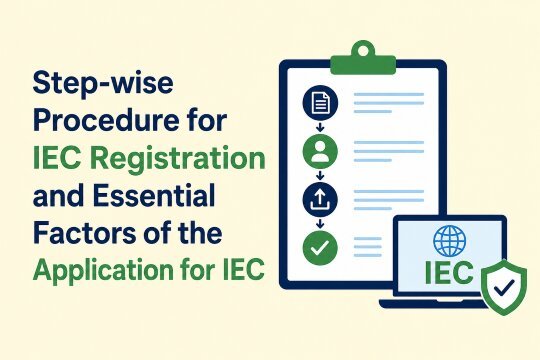
    Step-wise Procedure for IEC Registration and Essential Factors of the Application for Import Export Code IEC

    Step-wise Procedure for Importer-Exporter Code (IEC) Registration:

    1. Visit the DGFT Online Portal and Login after Initial Registration as User (https://www.dgft.gov.in/CP/)
    2. Category of Exporter: Merchant/ Manufacturer, Merchant and Manufacturer, Service Provider and Others
    3. Fill the Application Form ANF 2A with required attachments a below
      • Ensure the Validity of Mobile Number and Email Id by OTP verification
      • Permanent Account Number (PAN) Validation
      • Verification of Bank Account through Cancelled Cheque/ Bank Certificate
      • Business Identity i.e MSME Registration, Labour Licence, Certificate of Incorporation etc
      • Address Proofs: Aadhaar Card Valid for Proprietors and Individual, Rental Agreement/ Lease Deed/ Property Tax Receipt/ Sale Deed/ Ownership Proof/ Electricity Bill etc.
      • Passport Sized Photograph of the Proprietor/ Authorised Signatory  
    4. Details of Export Oriented Unit (EOU), Electronic Hardware Technology Park (EHTP) Scheme, Software Technology Park (STP) Scheme or Bio- Technology Park (BTP) etc, If applicable.
    5. Selection of the Details of Import and Export of goods and services.
    6. Submission of the Application with the Digital Signature/ E-Sign/ Aadhaar Verification. The details available with attached weblink (https://www.dgft.gov.in/CP/)
    7. An application fee of INR. 500/- is required for an initial application of IEC, and INR. 200/- applicable only for the structural modifications of details and “Zero” for other changes and the linkage of an IEC allotted before the July 1, 2017.  
    Essential Factors of the Application for Importer-Exporter Code (IEC)
    • The Regional Jurisdiction of the DGFT is applicable based of the Place of Business of Entity.
    • The DGFT Online Portal integrates the Ministry of Corporate Affairs (MCA) (www.mca.gov.in) database to pre-fill the director master data for registered LLPs and Companies.
    • Applicants should ensure the integration of Aadhaar and PAN data to sign an IEC Application through Aadhaar Validation  
    • The Persons importing or exporting goods for personal use with no connection to any trade, manufacture and agriculture do not need to take IEC.
    • The Government Departments have been operating with the special IEC numbers with ten digit format.
    • The IEC Management Function on the DGFT Online Portal also enables the users to apply for IEC changes, such as profile link, view, print, update, modify, surrender, request for revoking suspensions or cancellations, mergers and demergers etc.   

    Renewal and Update of the IEC: An IEC is issued with lifetime validity in general but renewal by updating is on annual basis (financial year) which is mandatory as per the regulations with window between April 1 and June 30. This is an annual process even if there are no updates to the business information, otherwise, the IEC will be deactivated.
    Renewal and Update of the IEC and The registrations hereunder require mandatory Import Export Code IEC alignment
    The registrations hereunder require mandatory Importer-Exporter Code (IEC) alignment: – It is hereby noted that the list is not exhaustive.
    • Registration as Exporter with the Spices Board, Coir Board, Rubber Board, Tobacco Board, Tea Board, Coffee Board, Coconut Development Board, Jute Board and Central Silk Board.
    • The Legal Entity Identifier (LEI), is an Identification Code issued by Legal Entity Identifier India Limited (LEIL), a wholly-owned subsidiary of the Clearing Corporation of India Limited (CCIL), to ensure the legitimacy of large financial transactions and ease the export credit for international trade.
    • The GST Registration Number (GSTIN) issued under the CGST Act, 2016: Fundamentally No mandatory alignment with IEC but mandatory for Export of Goods and Services without Payment of GST by execution of a Letter of Undertaking (LUT).  
    • Registration as Exporter with APEDA (Agricultural Products), MPEDA (Marine Products), FSSAI License (food exporters).
    • AD Code (Authorized Dealer) Requires an active IEC to link the bank account with customs at the port i.e Sea Port or Air Port etc.
    • DGFT Export Schemes (RoDTEP / Drawbacks): To claim the duty drawbacks or international trade benefits from the Government.
    • Registered Startups/ Companies/ LLP at Special Economic Zone (SEZ), EOU, STP and BTP etc.
    • Registrations with FIEO (Federation of Indian Export Organisations), Apparel Export Promotion Council (AEPC), Council for Leather Exports (CLE), Pharmexcil (Pharmaceuticals Export Promotion Council), EEPC India (Engineering Export Promotion Council), GJEPC (Gems and Jewellery Export Promotion Council), and ICEGATE Registration (Indian Customs Electronic Gateway).
    Queries & Solutions on Import and Export IEC
    Practical Issues: Queries & Solutions on IEC

    Q-1: Does an IEC holder have to file regular or nil returns like GST, ROC or Income Tax?
    Sol: No. The IEC is a legal status identification code, not a tax record identification number. There is no need to file any returns to keep it active. You need to renewal by updating on annual basis with window between April 1 and June 30.

    Q-2: If multiple manufacturing units in two states under the same Entity PAN. Do we need IEC for each of units?

    Sol: No. You cannot have multiple IECs. The Rule of “One IEC for One PAN”, shall be applied. The branches can be managed by adding them under one single IEC. Register your additional units by updating the “Branch Details” section on the DGFT Online Portal.

    Q-3: What happen if missed the annual profile update deadline on June 30, 2026. What are the immediate consequences at DGFT/ customs, and how do we re-activate the IEC?
    Sol: The Import Export Code IEC was automatically deactivated on July 1, 2026. Customs via ICEGATE will block your operations. You can re-activate through the DGFT Online Portal. There is no monetary penalty, and reactivation takes three to seven working days.

    Practical Issues Continuity-1

    Q-4: Can a foreign national or an NRI apply for an IEC to start a trade business in India?
    Sol: Yes, the entity must possess a valid PAN after Registration under the Indian Laws, a place of business address in India, and an active corporate current bank account. The foreign national can e-sign the application using a Digital Signature Certificate (DSC).

    Q-5: I am a gig software engineer receiving international contract works. Do I legally require an Import Export Code IEC if I do not deal physical goods?

    Sol: Yes. Indian banks require an IEC to process foreign inward remittances for services under FEMA and RBI regulations.

    Q-6: What is an Authorized Dealer Code, and why is our new IEC not working at the port despite being active on the DGFT site?

    Sol: Your Import Export Code IEC, allows you to trade, but you cannot clear customs until you register an Authorized Dealer (AD) Code. Request your bank to issue an AD Code confirmation letter, and upload it directly to the port profile on the ICEGATE portal.

    Q-7: What is the difference between IEC requirements for export of goods and export of services?
    Sol: IEC is generally required for exporting goods. For exporting services, IEC is required only in specified cases under the applicable DGFT rules.

    Q-8: What is the difference between IEC and an export licence?

    Sol: IEC identifies an importer or exporter. An export licence allows the export of specific, restricted, or controlled goods as required under applicable regulations.

    Q-9: Is an IEC sufficient to export a product listed under SCOMET?

    Sol: No, an IEC only identifies you as an importer or exporter. If your product is on the SCOMET list, you need a separate SCOMET export licence from DGFT. You can apply for the licence through the DGFT portal using your valid IEC.

    Authored by Team Rymerg

    About the Author:

    A Corporate Professional, having the Post Qualification Experience of Fifteen Years Plus, in the areas of Corporate Laws and Governance, Regulatory Reporting, Contract Management, Compliance and Risk Governance.

    Please contact us if you require professional advice. https://rymergz.me/contact-us/

  • Blog - Intellectual Property

    Role of Intellectual Property in Corporate Brand Protection

    Brand safety cannot be ensured by registering a name as Company/LLP

    Role of Intellectual Property in Market Positioning, Branding, and Global Trade

    Safeguarding business brand identity and market value is far more vital than mere entity registration under corporate law. Startup Business founders and prospective entrepreneurs must understand the differences between corporate entities and intellectual property protections. This article explores the legal foundations of Companies, Limited Liability Partnerships (LLPs), and Trademarks, their value to stakeholders, and their strategic impact on business operations.

    Legal Foundations and Genesis: Understanding corporate structures and intellectual property requires analyzing their distinct statutory frameworks.

    DetailsCompanyLLPTrademark
    Applicable LawCompanies Act, 2013Limited Liability Partnership Act, 2008Trade Marks Act, 1999
    Function    Creates a separate legal entity distinct from its shareholders, directors and administrationHybrid structure combining the operational flexibility of a traditional partnership with the limited liability of a company.Protects intangible intellectual property rights rather than creating a business entity. Protects brand identity, logos, and distinct market markers.
    Primary Object        Offers perpetual succession and limited liability. It operates as an artificial juridical person capable of holding property and suing or being sued in its own nameInternal structure is governed by a mutual LLP Agreement rather than rigid statutory provisions, offering compliance relief for small and medium enterprises.  Grants exclusive statutory rights to use a specific mark (name, logo, slogan, or shape) in commerce. It prevents unauthorized third parties from capitalizing on the brand’s goodwill. Can be assigned, licensed, or sold globally

    Value to Stakeholders through Branding

    Value to Stakeholders
    StakeholdersCompany and LLPTrademark
    Shareholders and Investors  Provide limited liability, protecting personal assets from business debts. Equity shares in a Company offer clear valuation metrics and exit routes for Venture Capital (VC) and Private Equity (PE) firms through secondary markets and public offerings.Drive enterprise value. Investors evaluate trademark portfolios to ensure a target entity owns its brand rights exclusively, avoiding future infringement liabilities.
    Consumers and Other Stake Holders    Ensure corporate accountability, financial transparency, and compliance via public registries like the Ministry of Corporate Affairs (MCA) and other regulators.  Serve as a badge of origin and quality assurance. They protect consumers from confusion, deception, and counterfeit goods in the open market.

    Market Positioning, Branding, and Global Trade

    When evaluating market positioning across retail, wholesale, and international trade, trademark registration heavily prevails over mere corporate name registration. Ministry of Corporate Affairs (MCA) name approval for companies and Limited Liability Partnerships (LLPs) secures only a local corporate registry status (within India); it does not grant a right to use that name in commerce, nor does it secure exclusive, market-wide brand trading rights. Consequently, trademarks command absolute priority in retail, e-commerce, and export trades, providing the definitive legal framework required to protect a brand from infringement and establish nationwide market exclusivity.

    The Company/ LLP Registration: The Company/ LLP name approval from the Ministry of Corporate Affairs (MCA) https://www.mca.gov.in/content/mca/global/en/home.html establishes entity-level exclusivity against identical Company or LLP registrations, but it does not confer proprietary branding rights. Operational use of the approved name remains strictly subject to trademark laws, meaning company registration provides no legal defence against infringement claims if the name conflicts with a pre-existing registered trademark.

    Retail and E-Commerce Dominance: “Verified trademark registration” is the primary mechanism for controlling product listings and removing counterfeiters on major e-commerce platforms like Amazon and Flipkart.

    Import and Export Operations and Customs Enforcement: Registered trademarks are essential for cross-border intellectual property protection, as customs authorities rely entirely on national trademark databases to identify and confiscate counterfeit goods. In contrast, a corporate name only registers a business entity locally and provides no legal authority to stop infringing imports. To prevent international piracy, companies must record their active trademark registrations directly with global customs agencies, enabling border officers to legally seize and destroy unauthorized cargo.

    Name Changes of Companies and LLPs: The Role of Intellectual Property

    Name Changes of Companies and LLPs: The Role of Trademark/Brand/Copyright:

    Altering the corporate name of a Company or Limited Liability Partnership (LLP) requires strict compliance with statutory frameworks beyond corporate law, specifically the Trade Marks Act and the Copyright Act. Failure to conduct due diligence under these statutes can result in infringement claims, injunctions, and forced subsequent alterations.

    • Preventing Infringement Litigation under the Trademark Law: Under Section 4 and Section 16 of the Companies Act, 2013, the MCA will reject a proposed corporate name change if it is identical to or closely resembles an existing registered trademark.
    • Copyright Law: Under the Copyright Act, 1957, copyright ownership attaches automatically upon creation if a corporate name change involves a new logo or stylized artistic text. Registering this copyright prevents competitors from copying the exact visual design of the corporate identity.
    • Passing-Off Risks: Changing a corporate name to match a competitor’s unregistered but popular brand name can trigger a common-law “passing-off” lawsuit, resulting in injunctions and damages.

    Strategic Brand Value: Driving Corporate Success in M&A, IPOs, and Financial Distress:

    Intellectual property acts as a critical financial asset during corporate transactions, offering value through asset sales and collateral in distress scenarios, higher valuations in M&A, and competitive advantage in IPOs. A strong IP portfolio ensures market confidence and drives valuation in both mergers and public offerings.

    • Financial Distress and Insolvency: The Insolvency and Bankruptcy Code (IBC), 2016 values registered trademarks as intangible corporate assets. If a company faces liquidation, liquidators can auction, sell, or license its trademark portfolio separately to maximize recoveries for financial creditors.
    • Mergers & Acquisitions (M&A): In M&A transactions, comprehensive IP due diligence is essential. A robust trademark portfolio increases corporate valuation, validates market dominance, and justifies premium acquisition prices.
    • IPOs, SME-IPOs, and Private Equity: Institutional investors and retail markets evaluate a company’s proprietary technology and brand equity before investment. Prospectuses filed for Initial Public Offerings (IPOs) require detailed disclosures of all registered, pending, and disputed trademarks. Unprotected brands create significant investment risks, which can negatively affect share pricing.
    • Strategic Contracts: Companies can leverage trademarks through franchising models, technology transfers, and licensing agreements to generate high-margin royalty streams without expanding physical infrastructure.
    Specialized Frequently Asked Questions (FAQ) on Corporate Brand Protection

    Specialized Frequently Asked Questions (FAQ) on Business Brand Identity Management Beyond the Registrations of Companies and LLPs.

    1. Does registering a company name with the MCA give me the right to use it as a brand name?

    No. MCA name approval only confirms that no other company or LLP shares that corporate name. It does not protect you against trademark infringement if the name matches a registered trademark owned by someone else.

    2. Can an individual own a trademark, or must it be registered by a Company/LLP?

    An individual can own a trademark. The owner can later assign, sell, or license it to a Company, LLP, or any other commercial entity through a legal deed.

    3. What happens if my corporate name matches someone else’s registered trademark?

    The trademark owner can file a lawsuit for infringement or passing off. This can lead to court injunctions, financial penalties, and an MCA order forcing you to change your corporate name.

    4. Can a trademark be registered prior the Company or LLP is incorporated?

    Yes. An individual or promoter can file a trademark application as a “proposed to be used” mark. Once the Company or LLP is incorporated, the applicant can officially assign to the new corporate entity.

    5. How long do Company, LLP, and Trademark registrations valid?

    Government authorities keep Company and LLP registrations valid indefinitely as long as owners maintain annual statutory filings. A trademark registration remains valid for 10 years, and owners can renew it indefinitely every 10 years.

    6. Can an LLP transition into a Company while keeping its registered trademarks?

    Yes. During the conversion process, the trademark assets can be transferred to the new corporate entity through an assignment deed or operation of law, updating the registry via official structural filings.

    FAQ Continuity-1.

    7. What is the difference between Copyright and Trademark for a business?

    Trademarks protect brand identities, logos, slogans, and product names used in trade. Copyright protects original literary, dramatic, musical, and artistic works, such as website source code, marketing copy, and promotional videos.

    8. Can a trademark asset protect a company from bankruptcy liquidation?

    No. A trademark cannot stop liquidation, but it can be sold or licensed during the process to generate revenue and help pay off outstanding creditors.

    9. Can I protect my brand name internationally with an Indian Company registration?

    No. An Indian corporate registration only applies domestically. To protect your brand internationally, you must file trademark applications in individual target countries or use the international Madrid System.

    10. What is a trademark class, and why does it matter to a Company or LLP?

    The trademark registry divides goods and services into 45 distinct classes. A business must register its mark in the specific classes that match its commercial operations to secure proper protection.

    11. Can a company register a trademark for a color or a sound?

    Yes. Non-traditional trademarks, including distinct color combinations and unique sound clips, can be registered if they uniquely identify the brand to consumers.

    12. Can a trademark application be rejected if the word is generic?

    Yes. Under Section 9 of the Trade Marks Act, 1999, absolute grounds for refusal apply to generic terms (e.g., registering “Apple” for selling physical apples) because they lack distinctiveness.

    FAQ Continuity-2

    13. What is the difference between the ™ and ® symbols?

    The ™ symbol indicates an unregistered trademark that is currently being claimed or processed but no vested legal rights under the trademark law. The ® symbol can only be used after the trademark is officially registered with the TM registry.

    14. Is trademark insurance available for Companies and LLPs?

    Yes. Specialized intellectual property insurance exists to help businesses cover the legal costs of defending their trademarks or pursuing infringement claims against counterfeiters.

    15. Can a company use its trademark as collateral for a bank loan?

    Yes. Financial experts can value registered trademarks, and corporations can use them as intangible collateral to secure credit facilities, loans, and structured financing.

    Authored by Team Rymergz

    About the Author:

    A Corporate Professional, having the Post Qualification Experience of Fifteen Years Plus, in the areas of Corporate Laws and Governance, Regulatory Reporting, Contract Management, Compliance and Risk Governance.

    Please contact us if you require professional advice. https://rymergz.me/contact-us/