Import Export Code IEC for Startup, MSME in 2026
How to Apply for Importer-Exporter Code (IEC): Need, Eligibility and Relevancy to Other Registrations related to International Trade for MSME and Startup.
Import Export Code IEC i.e Importer-Exporter Code, is a Fundamental Document for the Import and Export of goods and services. The Directorate General of Foreign Trade (DGFT), Ministry of Commerce and Industry, GOI, issues the Importer Exporter Code (IEC), under the Foreign Trade (Development & Regulations) Act, 1992, which is mandatory for Exports or Imports.
Need of an Import Export Code IEC
A. Compliance of Regulatory Frameworks
- Foreign Trade Policy and Customs Clearances
- Import and export of goods and services
- Cross-border financial transactions including abroad fundings like FDI, ECB Etc
B. Government Benefits
- Export of Goods and Services without Payment of GST by execution of a Letter of Undertaking (LUT)
- Duty Drawbacks Schemes
- Incentives for Special Economic Zone (SEZ), EOU, STP and BTP etc
- Benefits under Foreign Trade Policy
C. Business Transactional Needs
- Global Market Advantages
- Strategic Advantages for business expansion
- Ease of Cross-border Logistics
Who “can” Apply for Import Export Code IEC:
- Individuals and Sole-proprietorships
- Partnership under the Indian Partnership Act, 1932
- LLP under the Limited Liability Partnership Act, 2008 including Foreign and Govt Companies
- Companies under the Companies Act, 2013 including OPC, Foreign and Govt Companies
- Foreign subsidiaries, Joint Ventures, and Branch offices under the Companies Act, 2013
- Other Structures: Hindu Undivided Families (HUFs), Trusts, Societies, Charitable organizations and NGO’s
Who “cannot” Apply for Import Export Code IEC:
- Any Person and Entities without an active and valid Permanent Account Number (PAN) and Bank Account
- Any Person and Entities has been blacklisted and or suspended by the DGFT
- The Liaison Office under the Companies Act, 2013, cannot apply for IEC (May occasionally be approved for non-commercial use)
The Relation between PAN and IEC:
- The PAN also functions as IEC on approval of an IEC Application by the DGFT, w.e.f July 1, 2017.
- The Rule of “One IEC for One PAN”, shall be applied
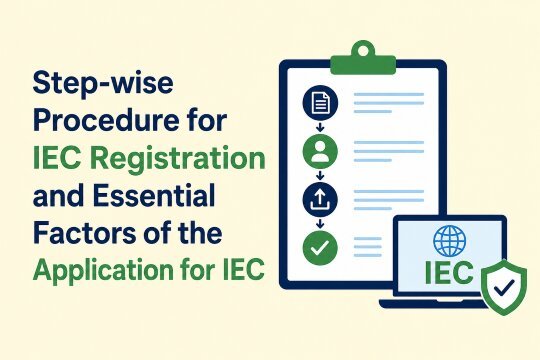
Step-wise Procedure for Importer-Exporter Code (IEC) Registration:
- Visit the DGFT Online Portal and Login after Initial Registration as User (https://www.dgft.gov.in/CP/)
- Category of Exporter: Merchant/ Manufacturer, Merchant and Manufacturer, Service Provider and Others
- Fill the Application Form ANF 2A with required attachments a below
- Ensure the Validity of Mobile Number and Email Id by OTP verification
- Permanent Account Number (PAN) Validation
- Verification of Bank Account through Cancelled Cheque/ Bank Certificate
- Business Identity i.e MSME Registration, Labour Licence, Certificate of Incorporation etc
- Address Proofs: Aadhaar Card Valid for Proprietors and Individual, Rental Agreement/ Lease Deed/ Property Tax Receipt/ Sale Deed/ Ownership Proof/ Electricity Bill etc.
- Passport Sized Photograph of the Proprietor/ Authorised Signatory
- Details of Export Oriented Unit (EOU), Electronic Hardware Technology Park (EHTP) Scheme, Software Technology Park (STP) Scheme or Bio- Technology Park (BTP) etc, If applicable.
- Selection of the Details of Import and Export of goods and services.
- Submission of the Application with the Digital Signature/ E-Sign/ Aadhaar Verification. The details available with attached weblink (https://www.dgft.gov.in/CP/)
- An application fee of INR. 500/- is required for an initial application of IEC, and INR. 200/- applicable only for the structural modifications of details and “Zero” for other changes and the linkage of an IEC allotted before the July 1, 2017.
Essential Factors of the Application for Importer-Exporter Code (IEC)
- The Regional Jurisdiction of the DGFT is applicable based of the Place of Business of Entity.
- The DGFT Online Portal integrates the Ministry of Corporate Affairs (MCA) (www.mca.gov.in) database to pre-fill the director master data for registered LLPs and Companies.
- Applicants should ensure the integration of Aadhaar and PAN data to sign an IEC Application through Aadhaar Validation
- The Persons importing or exporting goods for personal use with no connection to any trade, manufacture and agriculture do not need to take IEC.
- The Government Departments have been operating with the special IEC numbers with ten digit format.
- The IEC Management Function on the DGFT Online Portal also enables the users to apply for IEC changes, such as profile link, view, print, update, modify, surrender, request for revoking suspensions or cancellations, mergers and demergers etc.
Renewal and Update of the IEC: An IEC is issued with lifetime validity in general but renewal by updating is on annual basis (financial year) which is mandatory as per the regulations with window between April 1 and June 30. This is an annual process even if there are no updates to the business information, otherwise, the IEC will be deactivated.
The registrations hereunder require mandatory Importer-Exporter Code (IEC) alignment: – It is hereby noted that the list is not exhaustive.
- Registration as Exporter with the Spices Board, Coir Board, Rubber Board, Tobacco Board, Tea Board, Coffee Board, Coconut Development Board, Jute Board and Central Silk Board.
- The Legal Entity Identifier (LEI), is an Identification Code issued by Legal Entity Identifier India Limited (LEIL), a wholly-owned subsidiary of the Clearing Corporation of India Limited (CCIL), to ensure the legitimacy of large financial transactions and ease the export credit for international trade.
- The GST Registration Number (GSTIN) issued under the CGST Act, 2016: Fundamentally No mandatory alignment with IEC but mandatory for Export of Goods and Services without Payment of GST by execution of a Letter of Undertaking (LUT).
- Registration as Exporter with APEDA (Agricultural Products), MPEDA (Marine Products), FSSAI License (food exporters).
- AD Code (Authorized Dealer) Requires an active IEC to link the bank account with customs at the port i.e Sea Port or Air Port etc.
- DGFT Export Schemes (RoDTEP / Drawbacks): To claim the duty drawbacks or international trade benefits from the Government.
- Registered Startups/ Companies/ LLP at Special Economic Zone (SEZ), EOU, STP and BTP etc.
- Registrations with FIEO (Federation of Indian Export Organisations), Apparel Export Promotion Council (AEPC), Council for Leather Exports (CLE), Pharmexcil (Pharmaceuticals Export Promotion Council), EEPC India (Engineering Export Promotion Council), GJEPC (Gems and Jewellery Export Promotion Council), and ICEGATE Registration (Indian Customs Electronic Gateway).
Practical Issues: Queries & Solutions on IEC
Q-1: Does an IEC holder have to file regular or nil returns like GST, ROC or Income Tax?
Sol: No. The IEC is a legal status identification code, not a tax record identification number. There is no need to file any returns to keep it active. You need to renewal by updating on annual basis with window between April 1 and June 30.
Q-2: If multiple manufacturing units in two states under the same Entity PAN. Do we need IEC for each of units?
Sol: No. You cannot have multiple IECs. The Rule of “One IEC for One PAN”, shall be applied. The branches can be managed by adding them under one single IEC. Register your additional units by updating the “Branch Details” section on the DGFT Online Portal.
Q-3: What happen if missed the annual profile update deadline on June 30, 2026. What are the immediate consequences at DGFT/ customs, and how do we re-activate the IEC?
Sol: The Import Export Code IEC was automatically deactivated on July 1, 2026. Customs via ICEGATE will block your operations. You can re-activate through the DGFT Online Portal. There is no monetary penalty, and reactivation takes three to seven working days.
Practical Issues Continuity-1
Q-4: Can a foreign national or an NRI apply for an IEC to start a trade business in India?
Sol: Yes, the entity must possess a valid PAN after Registration under the Indian Laws, a place of business address in India, and an active corporate current bank account. The foreign national can e-sign the application using a Digital Signature Certificate (DSC).
Q-5: I am a gig software engineer receiving international contract works. Do I legally require an Import Export Code IEC if I do not deal physical goods?
Sol: Yes. Indian banks require an IEC to process foreign inward remittances for services under FEMA and RBI regulations.
Q-6: What is an Authorized Dealer Code, and why is our new IEC not working at the port despite being active on the DGFT site?
Sol: Your Import Export Code IEC, allows you to trade, but you cannot clear customs until you register an Authorized Dealer (AD) Code. Request your bank to issue an AD Code confirmation letter, and upload it directly to the port profile on the ICEGATE portal.
Q-7: What is the difference between IEC requirements for export of goods and export of services?
Sol: IEC is generally required for exporting goods. For exporting services, IEC is required only in specified cases under the applicable DGFT rules.
Q-8: What is the difference between IEC and an export licence?
Sol: IEC identifies an importer or exporter. An export licence allows the export of specific, restricted, or controlled goods as required under applicable regulations.
Q-9: Is an IEC sufficient to export a product listed under SCOMET?
Sol: No, an IEC only identifies you as an importer or exporter. If your product is on the SCOMET list, you need a separate SCOMET export licence from DGFT. You can apply for the licence through the DGFT portal using your valid IEC.
Authored by Team Rymerg
About the Author:
A Corporate Professional, having the Post Qualification Experience of Fifteen Years Plus, in the areas of Corporate Laws and Governance, Regulatory Reporting, Contract Management, Compliance and Risk Governance.
Please contact us if you require professional advice. https://rymergz.me/contact-us/