
“One Person Company (OPC)”: Its benefits, features and as a type of Private Limited Company under the Indian Corporate System.
A One Person Company (OPC) is a version of mixed business structure that combines the limited liability protection of a Private Limited Company with the features of a sole proprietorship under the Companies Act, 2013.
One Person Company facilitates a single entrepreneur to run the company on his/ her own. OPC represents a type of the private limited company under the Companies Act, 2013
OPC Name Examples : The word “OPC” shall be inserted as follows as per the company name regulations.
ABC Software (OPC) Private Limited
XYZ Exports (OPC) Private Limited
Basics of Company Registration including One Person Company
The Ministry of Corporate Affairs, is the apex regulator for registration and regulation of companies in India, as governed under the Companies Act, 2013.https://www.mca.gov.in/content/mca/global/en/home.html
The Company is an artificial juristic person with legal distinct identity from its Shareholder, Directors and Other Key Managerial Personal as defined under the Companies Act, 2013.The Company is a Separate Legal Entity in the eyes of law and society
Strategic Legal Considerations in the matter of the One Person Company Registration in India:
1. OPC is a Private Limited Company with one sole member who can also act as Director.
2. The OPC can have more than One Director with maximum limit of Fifteen.
3. The member of OPC, shall nominate a person as his/her Nominee with prior written consent, who shall become the member of that OPC, in the event of the death of member or incapacity to contract, respectively.
4. A “minor” cannot become a member or nominee of the OPC or hold shares with beneficial interest.
5. A person shall not be a member or nominee in more than one OPC at any point of time.
6. A single person can act as Member in One OPC and as Nominee in other One Person Company. If a nominee place triggers and said person becomes a member in two OPCs, then within a period of 180 days, he/she should choose any one OPC as a member and intimate the same to the MCA.
7. An OPC cannot carry Non-Banking Financial Investment (NBFC) activities, including investment in securities of any Company and LLP.
8. The member or shareholder of an OPC can be an Indian resident individual or non-resident Indian subjected to his/her stay in India for a period of not less than 120 (one hundred and twenty days) during the immediately preceding financial year. Hence, the Company Law allows NRI to register an OPC in India.
9. Company Law prohibits a Foreign National from forming an OPC in India
10. An OPC can convert into a private or public company but cannot convert into a “Section 8 company,” while a private company may convert into an OPC.
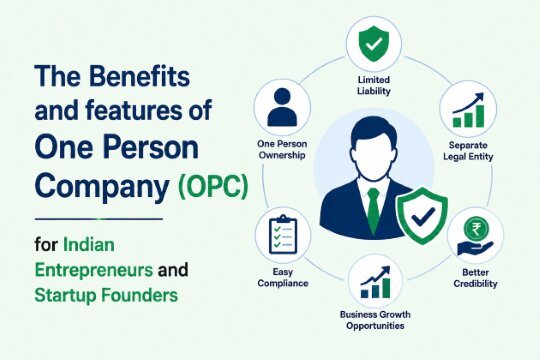
The Benefits and features of One Person Company (OPC) for Indian Entrepreneurs and Startup Founders:
- A feature of an OPC is forming a separate legal protection between personal and corporate wealth/Assets. Shareholder/ Member personal assets are legally inaccessible to the business creditors, and liability is strictly limited to the unpaid value of their subscribed share capital.
- The mandatory clause of an appointment of nominee ensures an immediate transfer of ownership without stumbling operations and also ensures perpetuity.
- In case of death of member, the One Person Company Contracts or agreements remains unaffected due to the Transmission of shares to nominee as per the Companies Act, 2013.
- The One Person Company can hold all types of tangible properties, like land, buildings, etc., and intangible properties like intellectual property (IP), know-how, Trademarks, Patents and other forms of Capital in its own name.
- OPCs are legally relieved from convening General Meetings i.e., Annual General meeting or Extraordinary General Meetings, as per the Company Law, being operated by a Single Member.
- OPCs are legally also relieved from convening mandatory number of Board Meetings under the Companies Act, 2013, subjected to Minimum of Two Board Meetings.
- An OPC can, at its convenience/ requirements, voluntarily convert to a Private Limited Company and can preserve its past track record, GST/ PAN history, Company Bank accounts, properties and other contractual rights and obligations.
Special Advantages for Tech-startups, Technocrat Projects
Special Advantages for Tech-startups, Technocrat Projects, as OPC has enabled to get registrations under the MSME/ Udyam, Startup India Schemes, Standup India Schemes, holding of registrations of Import Export Code (IEC), FSSAI, APEDA, Spices Board, Rubber Board, Coir Board etc
One Person Company (OPC) Frequently Asked Questions (FAQs):
Q-1: Is the foreign citizen and national but a person of Indian origin eligible to register an OPC in India?
No, Persons of Indian Origin (PIO) or Overseas Citizens of India/ OCI Card Holders, who have taken up foreign citizenship and passports cannot form an OPC in India.
Q-2: Can a corporate body eligible to register an OPC?
No. According to the Companies Act, 2013, Only natural persons are eligible to register the OPC.
Q-3: Is there any minimum authorised and paid-up capital requirement for starting a OPC?
No. The Companies Act, 2013 does not mandate capital requirement
Q-4. Can an OPC invest by purchasing or subscribing equity shares in another Private Limited Company?
No. An OPC cannot allowed to invest/ purchase shares/ ownership rights in any Company/ LLP/ Body Corporate.
Q-5. Can an OPC accept Foreign Funding?
No, FEMA Regulations prohibit an OPC from accepting foreign funding/FDI/ECB.
FAQ Continuity-1.
Q-6. Can an OPC give secured and unsecured loans to other OPC’s/ Companies?
Yes, It can lend money to another OPC/ body corporate out of profits generated from its business operations, subject to the provisions of the Companies Act, 2013 as related to the inter corporate loans
Q-7. What happens to the OPC in the event that the only member is officially declared bankrupt under the Insolvency Laws?
The member loses his ability to enter into contracts if a court finds them to be legally insolvent. Eventually, the Nominee can become the Member of the OPC, subject to the Transfer of the Ownership of the Shares, subject to the provisions of the Companies Act, 2013.
Q-8 Is apostillation of all Documents as related to Identification of an Non-Resident Indian (NRI) is required to form an One Person Company (OPC) in India?
No, in case of travel to India to register a OPC. Apostillation will be application where he/ she resides the country which is a part of Hague Convention.
Q-9. When is an attestation by the Indian Embassy and Consulate, required?
Applicable, where an NRI resides in Non-Hague Convention Countries (e.g., UAE, Saudi Arabia, Singapore).
Authored by Team RYmergZ
About the Author:
A Corporate Professional, having the Post Qualification Experience of Fifteen Years Plus, in the areas of Corporate Laws and Governance, Regulatory Reporting, Contract Management, Compliance and Risk Governance.
Please contact us if you require professional advice. https://rymergz.me/contact-us/